Lattice and Boolean Algebra
grid
The lattice defined by the partially ordered set
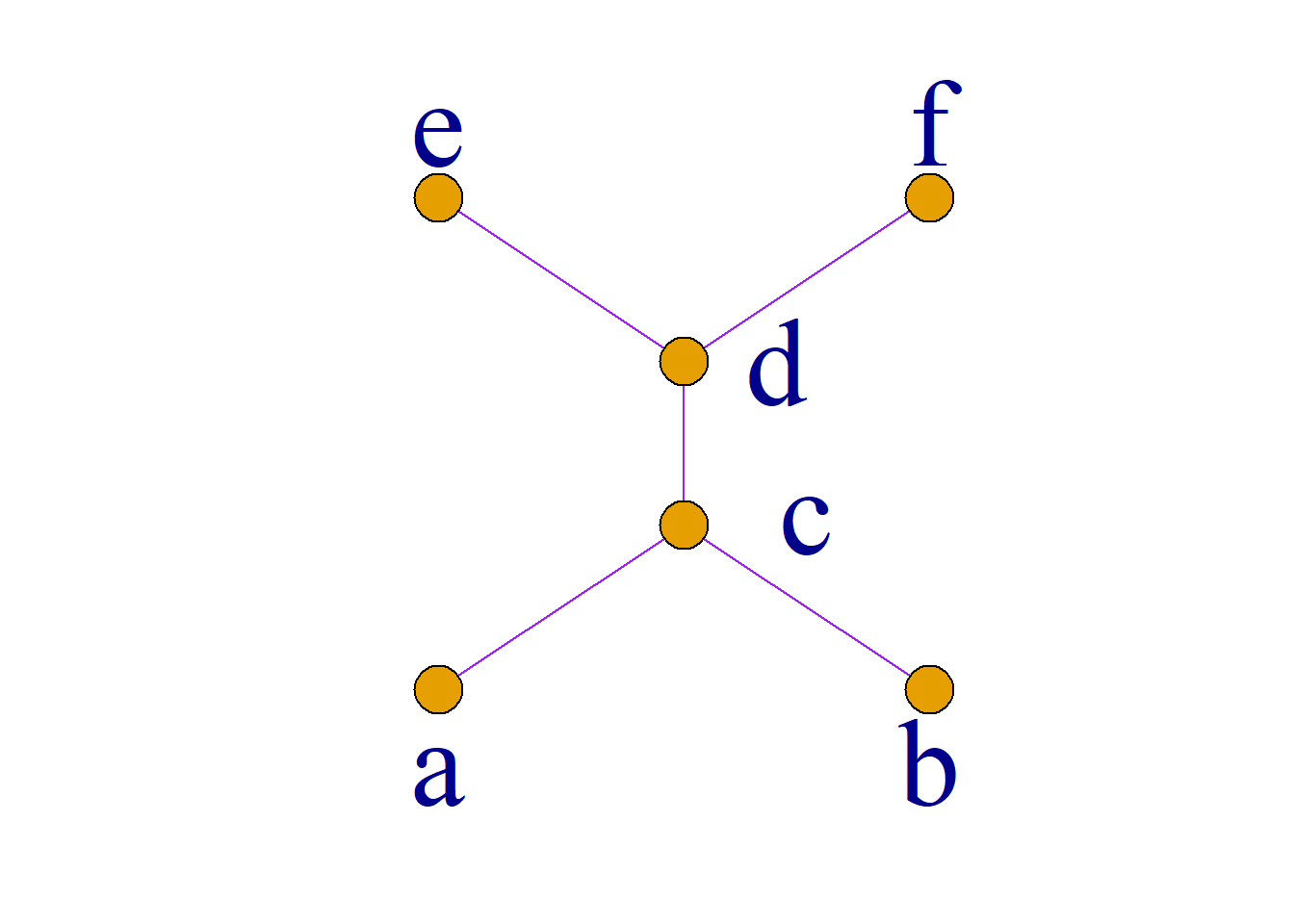
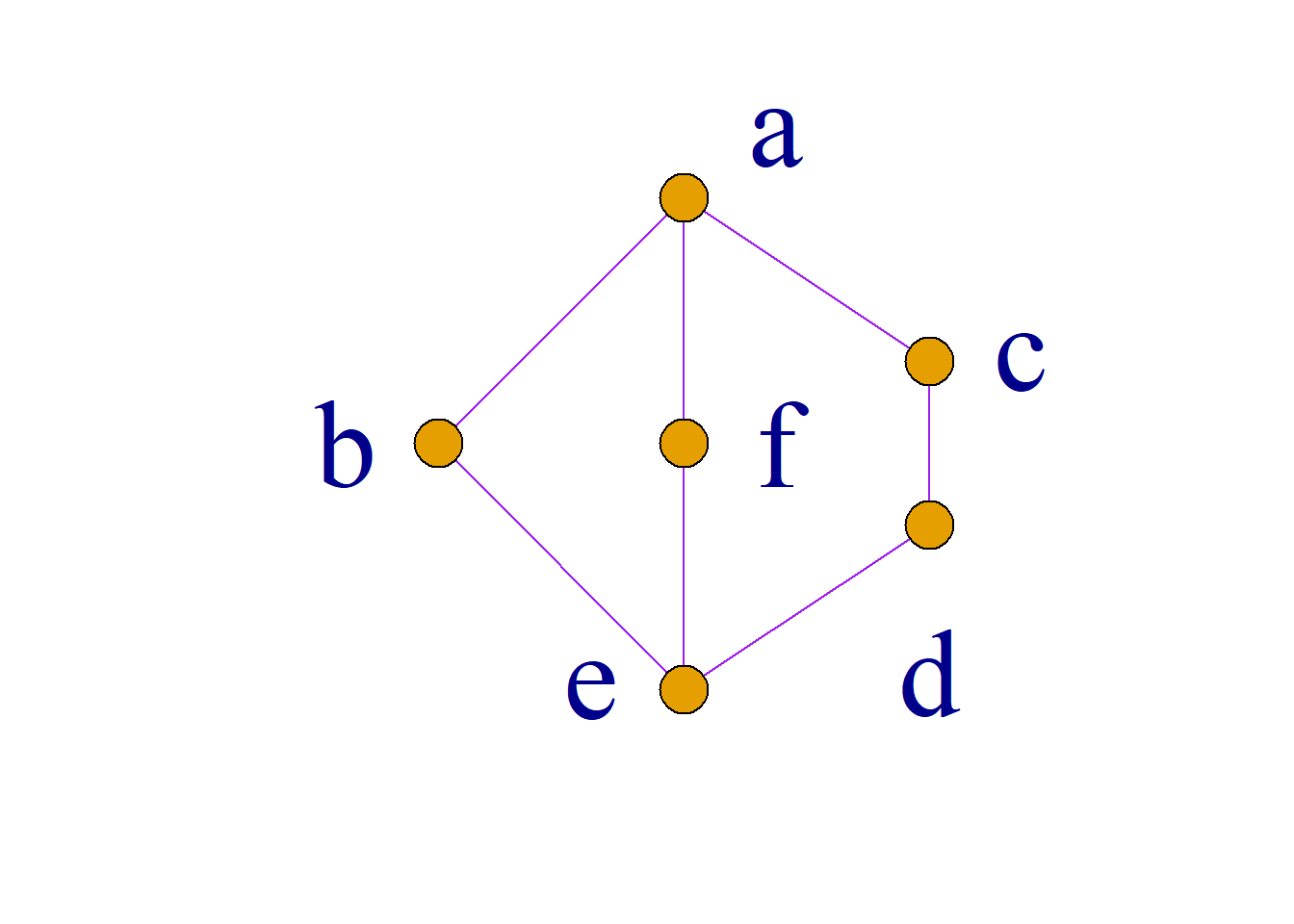
A partially ordered set \({\langle}S, {\leq}{\rangle}\), any subset \(T\) (\(T{\subseteq}S\)) may not have a maximum lower bound and a minimum upper bound. For example, take the partially ordered set as shown in the figure.
\(S=\{a, b, c, d, e, f\}\)
The minimum upper bound \(c\) of \(T_1=\{a, b\}\) has no maximum lower bound;
\(T_2=\{e, f\}\) has no minimum upper bound. The maximum lower bound is \(d\);
\(T_3=\{c, d\}\)The minimum upper bound is \(d\), and the maximum lower bound is \(c\).
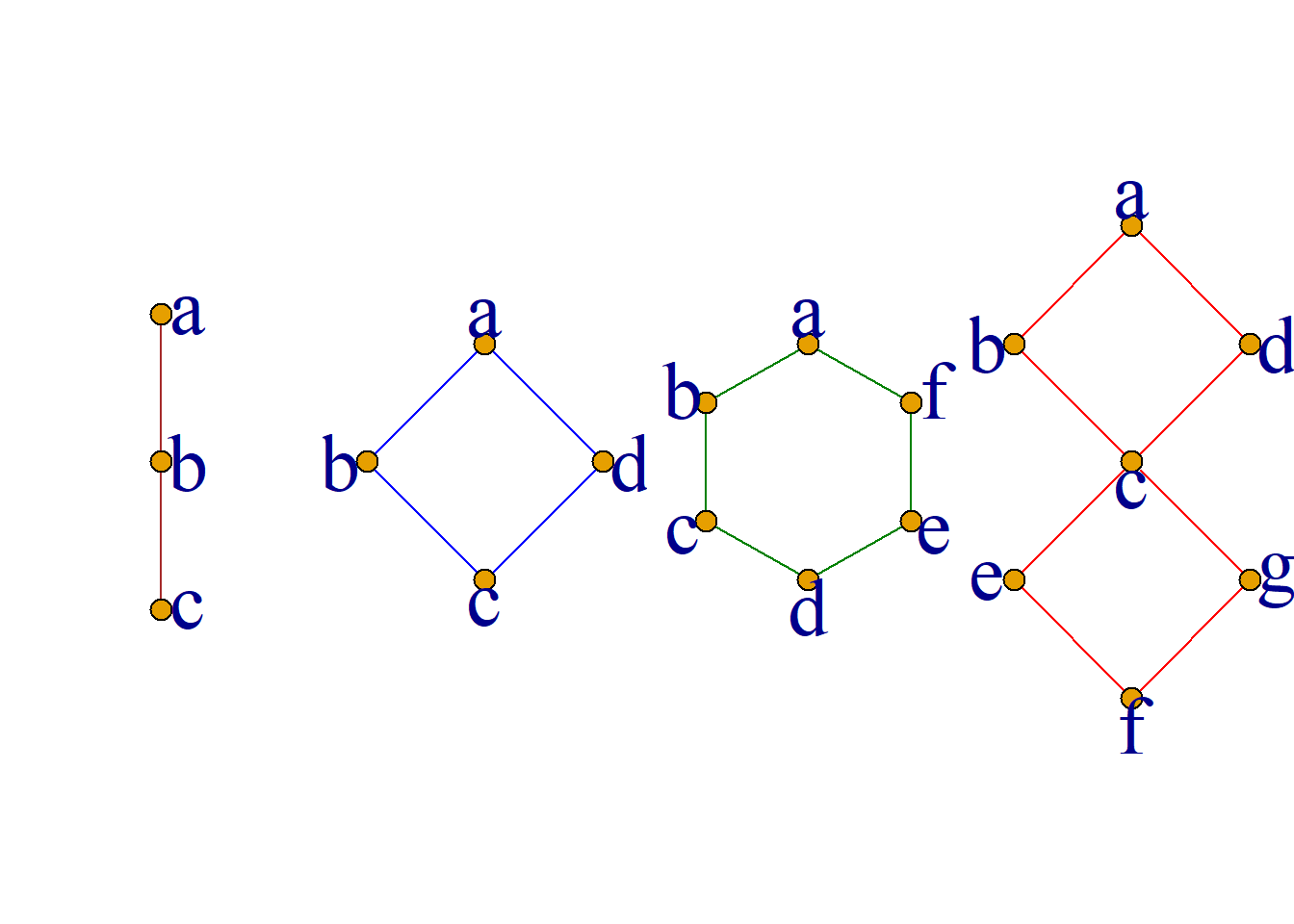
The following partially ordered sets all have a common property.
It is in this partially ordered set that any two elements have a minimum upper bound and a maximum lower bound.
We call a partially ordered set with this property a lattice.
Definition: Suppose \({\langle}L, {\leq}{\rangle}\) is a partially ordered set. If any two elements \(a\) and \(b\) in \(L\) have a minimum upper bound and a maximum lower bound in L, then \({\langle}L, {\leq}{\rangle}\) is called a lattice. The lattice defined in this way is also called partially ordered lattice.
Generally, \(a{\vee}b\), \(LUB\{a, b\}\) or \(sup\{a, b\}\) are used to represent the minimum upper bound (join or supremum) of \(a\) and \(b\). Use \(a{\wedge}b\), \(GLB\{a, b\}\) or \(inf\{a, b\}\) to represent the maximum lower bound (meet or infimum) of \(a\) and \(b\). \({\vee}\) and \({\wedge}\) are called the join operation and meet operation, respectively.
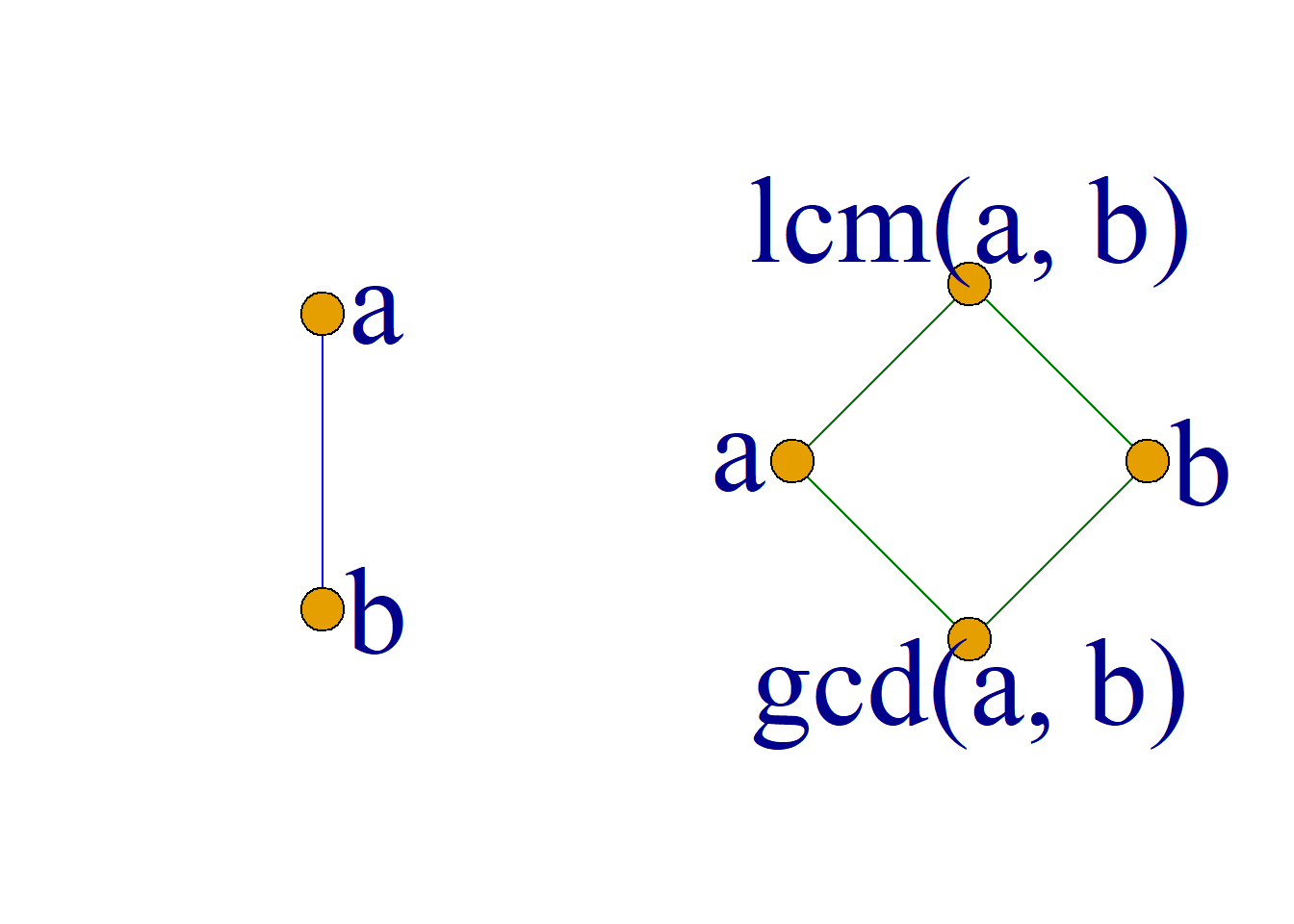
Example: Suppose \(Z^+\) is a set of positive integers, define the divisibility relationship | on \(Z^+\): For any \(a, b{\in}Z\) For \({\forall}a, b{\in}Z^+\), \({\langle}a, b{\rangle}{\in}|\) if and only if \(a\) divides \(b\), Then the partially ordered set \({\langle} Z^+, | {\rangle}\) is a lattice.
Proof:\[|=\{{\langle}a, b{\rangle}| a, b{\in}Z^+, a|b\}{\rangle}\] For \({\forall}a, b{\in}Z^+\), their minimum upper bound and maximum lower bound are the least common multiple and greatest common divisor of the two elements, that is: \[a{\vee}b=lcm(a, b){\in}Z^+, \] \[a{\wedge}b=gcd(a, b){\in}Z^+,\] Therefore \({\langle}Z^+, |{\rangle}\) is a lattice.
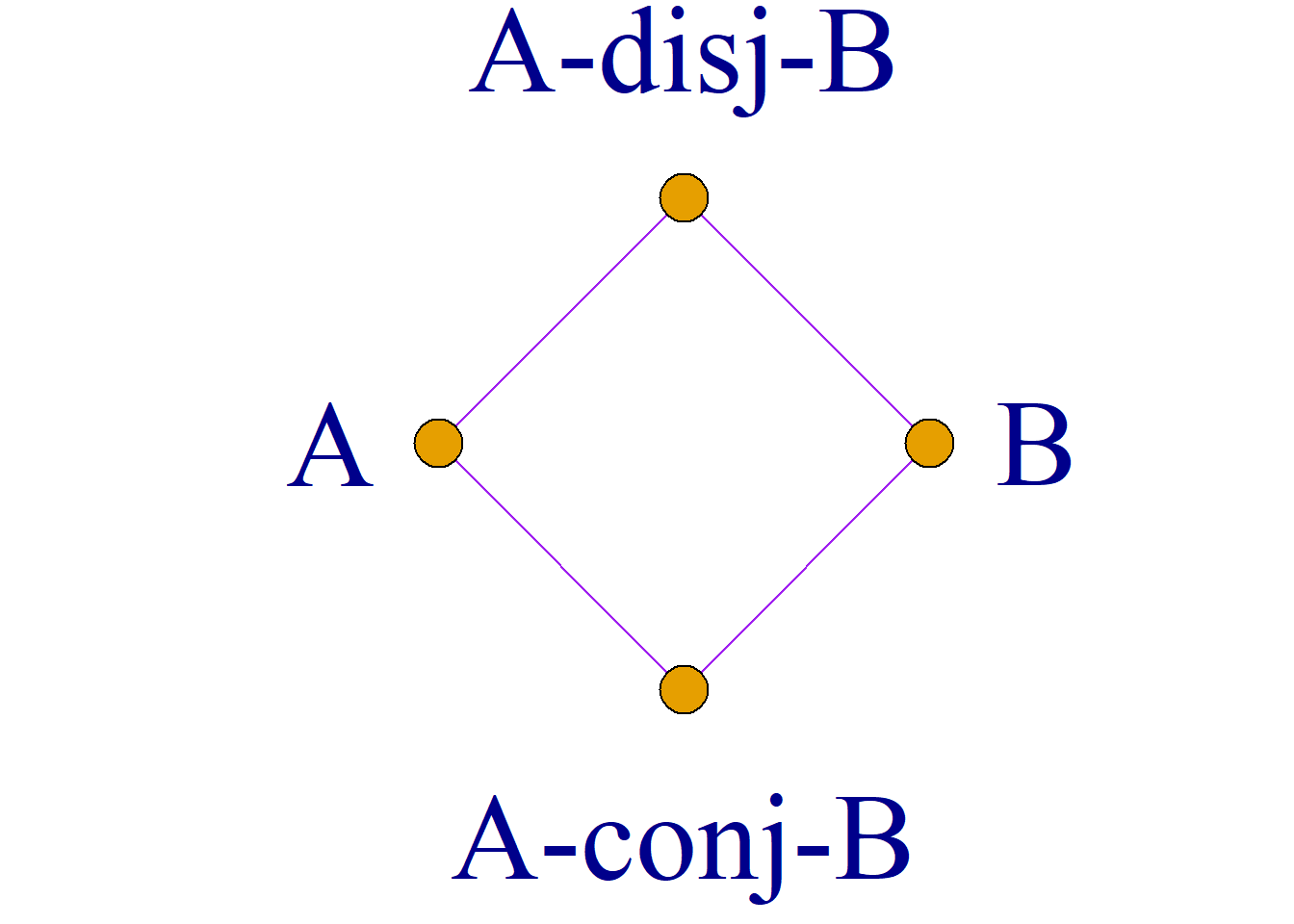
Example: For any set \(S, P(S)\) is the power set of \(S\), then the partially ordered set \({\langle}P(S), \subseteq{\rangle}\) is a lattice.
Proof: \[{\subseteq} = \{{\langle}X, Y{\rangle}|X, Y{\in}P(S), X{\subseteq}Y\}\] Because \({\subseteq}\) is a partial ordering relationship on \(P(S)\), and \({\forall}A, B{\in}P(S)\), their minimum upper bound and maximum lower bound are the union and intersection of the two sets respectively.
Right now \[A{\vee}B=A{\cup}B{\in}P(S)\] \[A{\wedge}B=A{\cap}B{\in}P(S)\] So it is a lattice. \({\langle}P(S), {\subseteq}{\rangle}\) is called the power set lattice of the set.
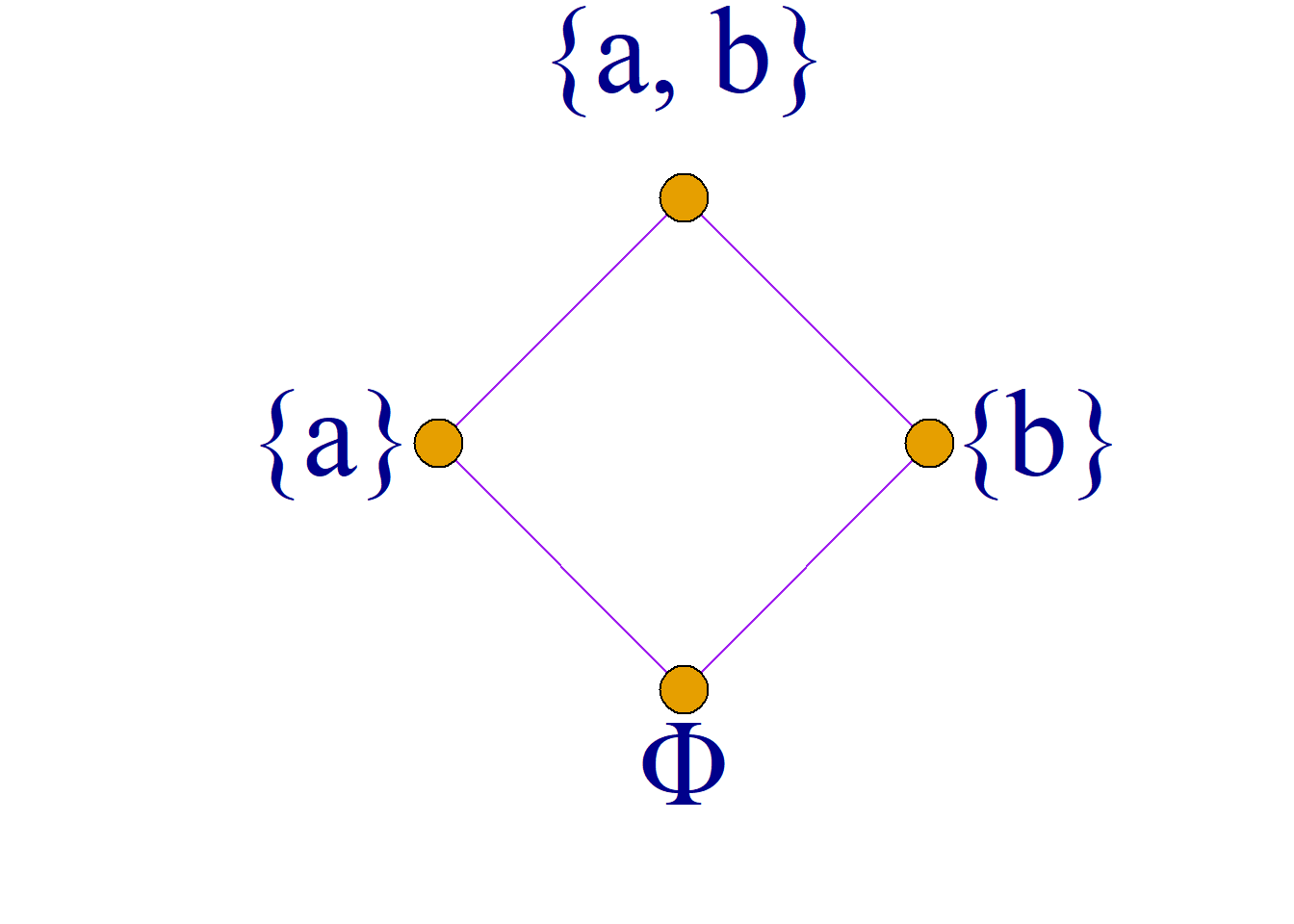
Example: Suppose \(S=\{a, b\}\),
\(P(S)=\{\phi, \{a\}, \{b\}, \{a, b\}\}\),
Then \({\langle}P(S), {\subseteq}{\rangle}\) is the lattice.
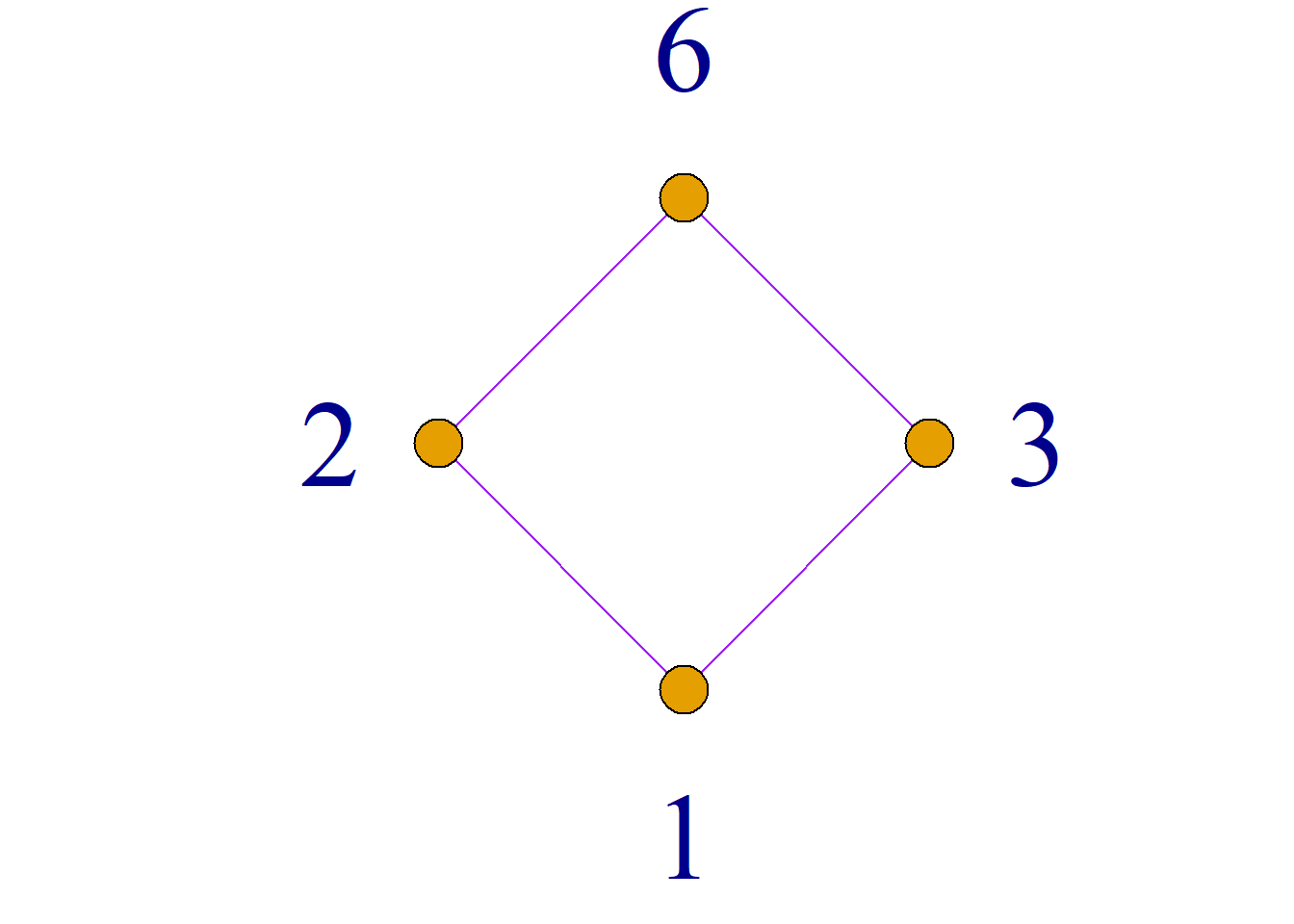
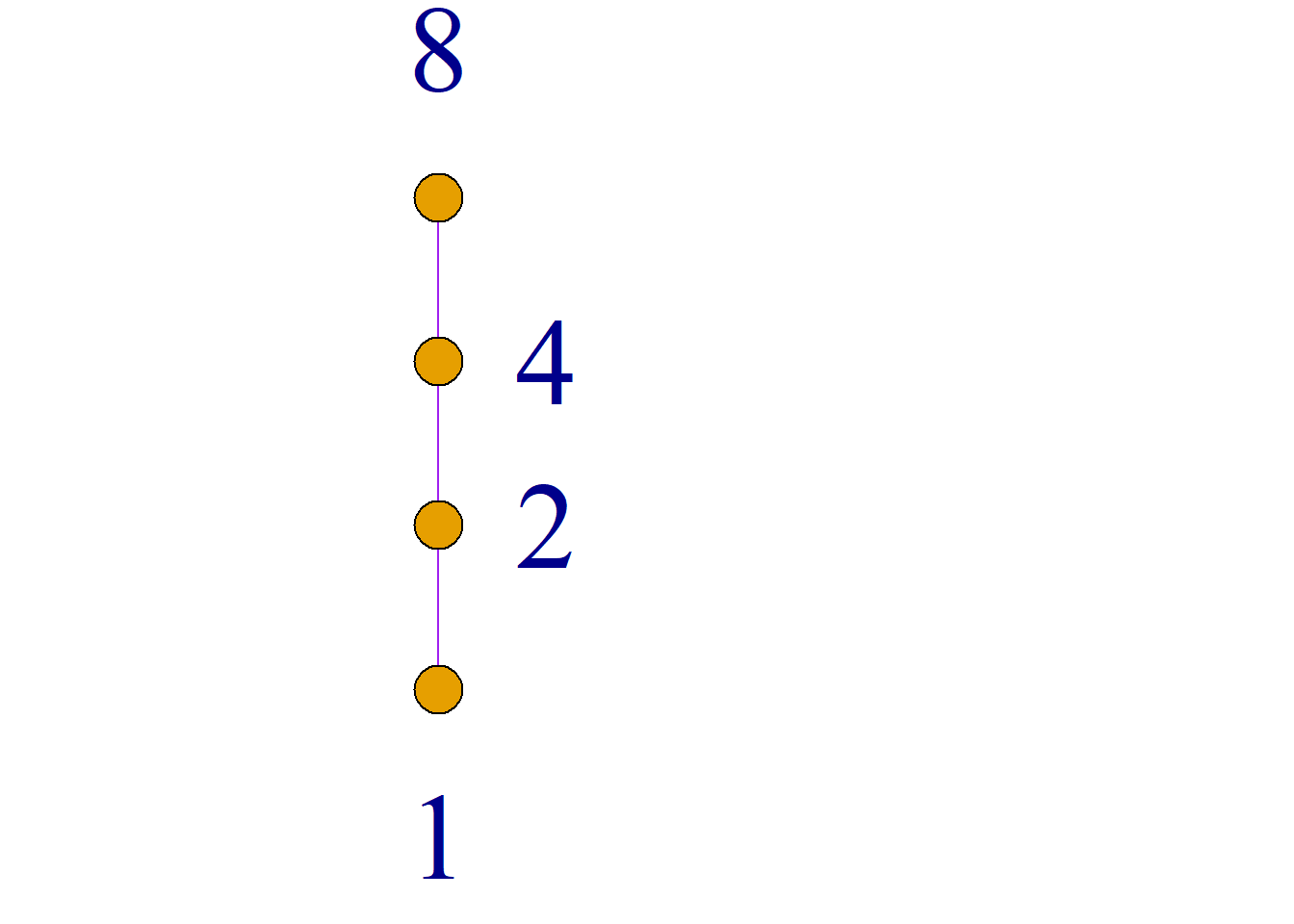
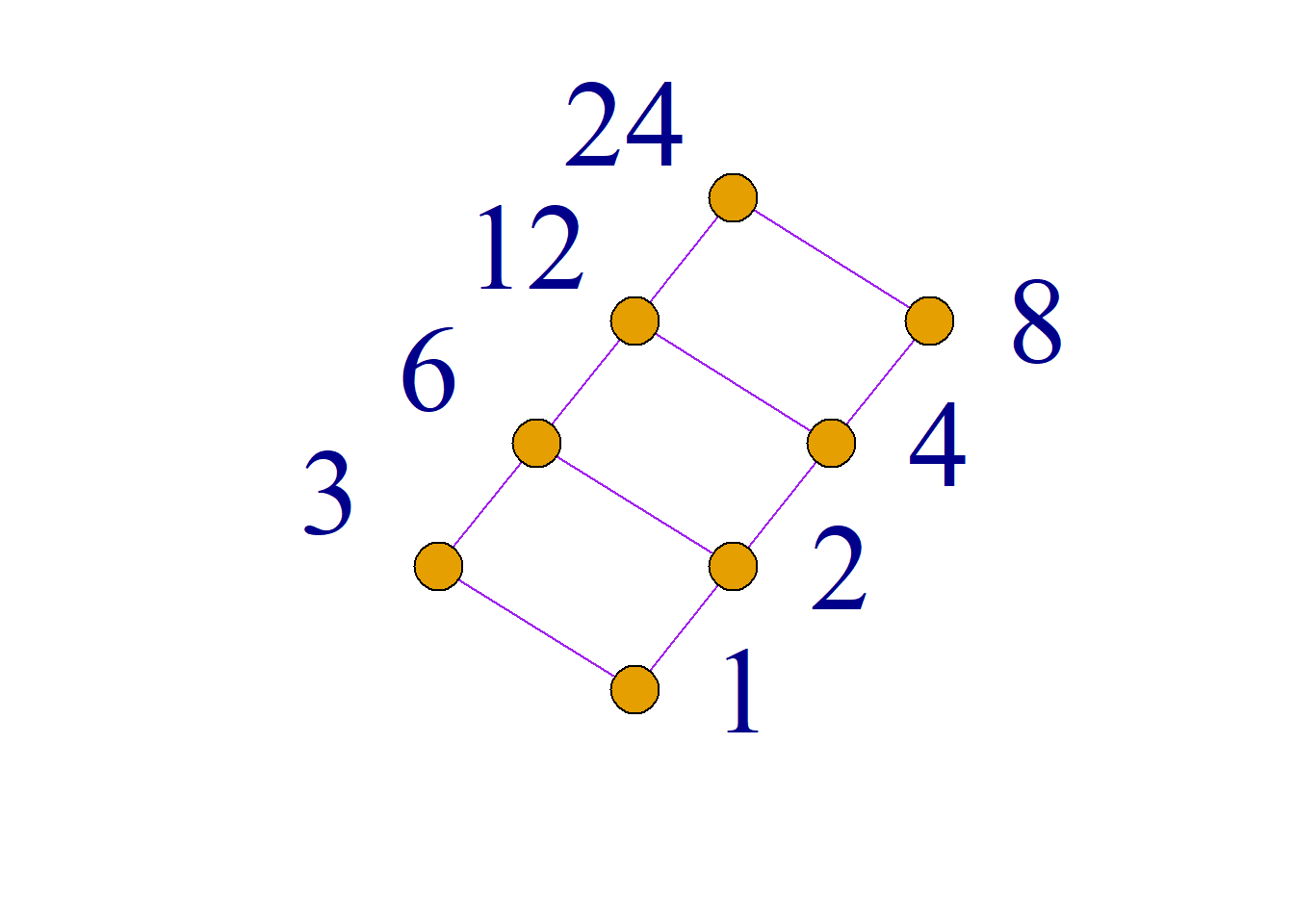
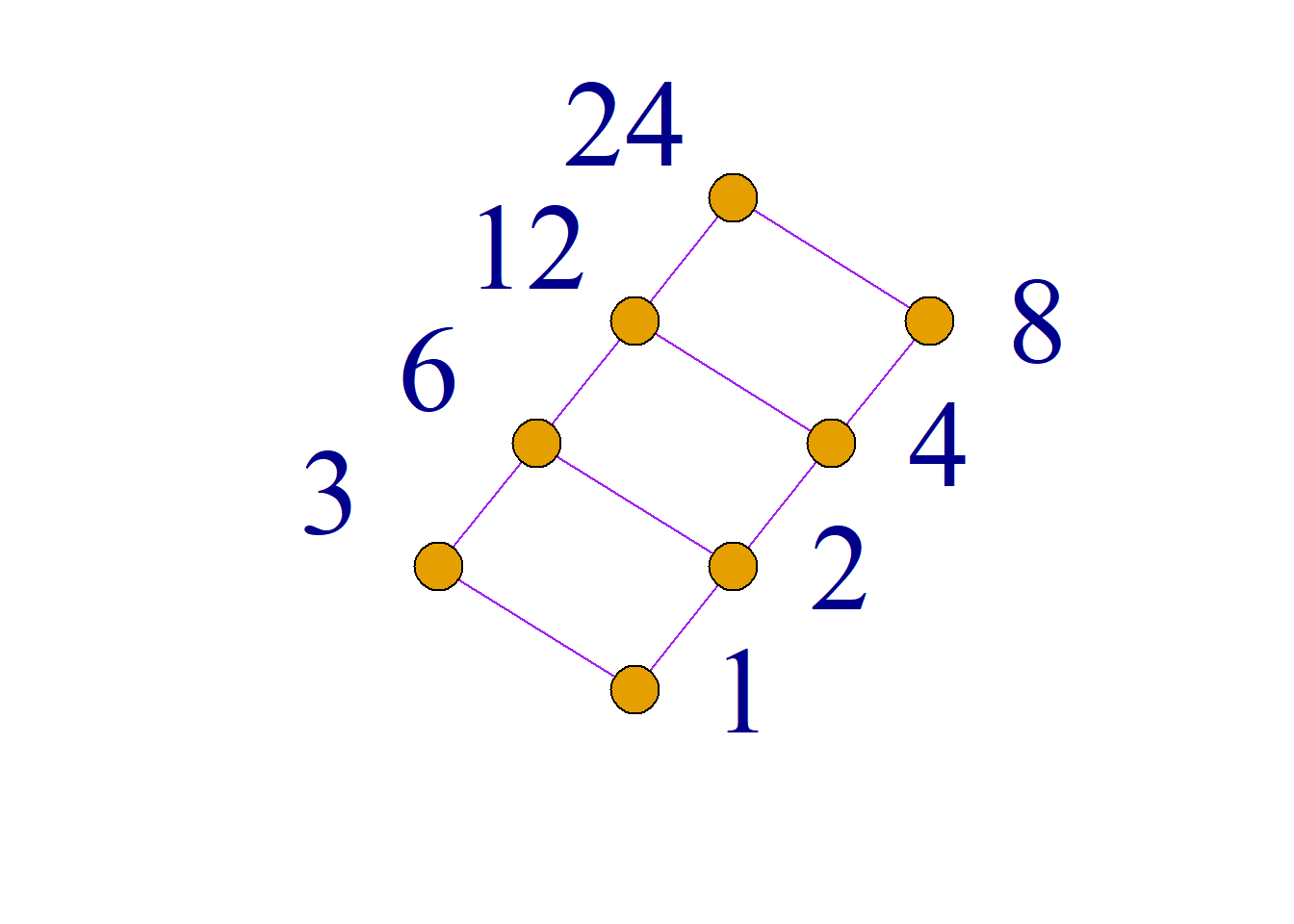
Example: Suppose \(n\) is a positive integer, \(S_n\) is the set of all positive factors of \(n\). For example: \[S_6=\{1, 2, 3, 6\}\] \[S_8=\{1, 2, 4, 8\}\] \[S_{24}=\{1, 2, 3, 4, 6, 8, 12, 24\}\] Also assuming that | is a divisibility relation, then the partially ordered set \({\langle}S_n, |{\rangle}\) is a lattice.
Suppose \({\langle}L, {\leq}{\rangle}\) are lattice, \({\geq}\) is the inverse relation of \({\leq}\), then lattice \({\langle}L, {\geq}{\rangle}\) is called the dual lattice of lattice \({\langle}L, {\leq}{\rangle}\) (each other is dual lattice), The relation \({\leq}\) and the relation \({\geq}\) are called dual relations.
Theorem: If \({\langle}L, {\leq}{\rangle}\) is a lattice, then \({\langle}L, {\geq}{\rangle}\) is also a lattice, and the union-preserving operation and intersection-preserving operation (expressed by \({\bigoplus}\) and \({\bigotimes}\)) in the lattice \({\langle}L, {\geq}{\rangle}\) are the same as the lattice ${}L, The union-preserving operation and intersection-preserving operation (represented by \({\vee}\) and \({\wedge}\)) in {}{}$ satisfy the following relationship:
For \({\forall} a, b{\in}L\), we have \(a{\vee}b=a{\bigotimes}b, a{\wedge}b=a{\bigoplus}b\).
Definition: The dual proposition of a proposition \(P\) consisting of the elements in the lattice \({\langle}L, {\leq}{\rangle}\) and the symbols \({\vee}, {\wedge}, =\) and \({\leq}\) is the proposition \(P^*\), which replaces \({\leq}\) in \(P\) with \({\geq}\), The proposition obtained by replacing \({\vee}\) with \({\wedge}\) and \({\wedge}\) with \({\vee}\).
For example, the dual form of the proposition \((a{\vee}b){\wedge}c{\leq}c\) is the proposition \((a{\wedge}b){\vee}c{\geq}c\). In fact, \((a{\vee}b){\wedge}c{\leq}c\) is the lattice \({\langle}L, {\leq}{\rangle}\), and \((a{\wedge}b){\vee}c{\geq}c\) is a proposition in the lattice \({\langle}L, {\geq}{\rangle}\) proposition.
Theorem: (Duality Principle) For any true proposition \(P\) in the lattice \({\langle}L, {\leq}{\rangle}\), its dual proposition \(P^*\) is also a true proposition.
Example: The dual proposition \(A{\cup}B{\supseteq}A\) of the true proposition \(A{\cap}B{\subseteq}A\) in the lattice \({\langle}P(S), {\subseteq}{\rangle}\) is also a true proposition.
Theorem: Suppose \({\langle}L, {\leq}{\rangle}\) is a lattice, then for any elements \(a\), \(b\) and \(c\) in L:
\(a{\leq}a{\vee}b, b{\leq}a{\vee}b\), \(a{\wedge}b{\leq}a, a{\wedge}b{\leq}b\)
If \(a{\leq}b, a{\leq}c\), then: \(a{\leq}b{\wedge}c\). If \(a{\leq}c, b{\leq}c\), then: \(a{\vee}b{\leq}c\).
If \(a{\leq}b, c{\leq}d\), then: \(a{\vee}c{\leq}b{\vee}d\), \(a{\wedge}c{\leq}b{\wedge}d\).
If \(b{\leq}c\), then: \(a{\vee}b{\leq}a{\vee}c\), \(a{\wedge}b{\leq}a{\wedge}c\).
Theorem: Suppose \({\langle}L, {\leq}{\rangle}\) is a lattice, then for any elements \(a\), \(b\) and \(c\) in \(L\), the following laws hold.
Idempotence law \(a{\vee}a=a, a{\wedge}a=a\)
Commutative law \(a{\vee}b=b{\vee}a, a{\wedge}b=b{\wedge}a\)
Associative law \((a{\vee}b){\vee}c=a{\vee}(b{\vee}c)\), \((a{\wedge}b){\wedge}c=a{\wedge}(b{\wedge}c)\)
Absorption law \(a{\vee}(a{\wedge}b)=a\), \(a{\wedge}(a{\vee}b)=a\)
Theorem: Suppose \({\langle}L, {\leq}{\rangle}\) is a lattice, then for any elements \(a\) and \(b\) in L, we have \(a{\leq}b{\Leftrightarrow}a{\wedge}b=a{\Leftrightarrow}a{\vee}b=b.\)
Theorem: Suppose \({\langle}L, {\leq}{\rangle}\) is a lattice, then for any elements \(a\), \(b\) and \(c\) in \(L\), we have:
\(a{\vee}(b{\wedge}c){\leq}(a{\vee}b){\wedge}(a{\vee}c)\).
\(a{\wedge}(b{\vee}c){\geq}(a{\wedge}b){\vee}(a{\wedge}c)\).
The relation \({\geq}\) is the dual relation of the relation \({\leq}\).
Theorem: Suppose \({\langle}L, {\leq}{\rangle}\) is a lattice, then for any elements \(a\), \(b\) and \(c\) in \(L\), we have: \(a{\leq}c{\Leftrightarrow}a{\vee}(b{\wedge}c){\leq}(a{\vee}b){\wedge}c.\)
\[ \begin{array}{ll} {\langle}L, {\leq}{\rangle}& {\langle}L, {\geq}{\rangle}\\ a{\leq}a & a{\geq}a \\ a{\leq}b{and}b{\leq}a{\Rightarrow}a=b&a{\geq}b{and}b{\geq}a{\Rightarrow}a=b\\ a{\leq}b{and}b{\leq}c{\Rightarrow}a{\leq}c&a{\geq}b{and}b{\geq}c{\Rightarrow}a{\geq}c\\ a{\wedge}b{\leq}a;a{\wedge}b{\leq}b&a{\bigoplus}b{\geq}a;a{\bigoplus}b{\geq}b\\ c{\leq}a{and}c{\leq}b{\Rightarrow}c{\leq}a{\wedge}b&c{\geq}a{and}c{\geq}b{\Rightarrow}c{\geq}a{\bigoplus}b\\ a{\wedge}b=b{\wedge}a & a{\bigoplus}b=b{\bigoplus}a \\ (a{\wedge}b){\wedge}c=a{\wedge}(b{\wedge}c) & (a{\bigoplus}b){\bigoplus}c=a{\bigoplus}(b{\bigoplus}c)\\ a{\wedge}(a{\vee}b)=a & a{\bigoplus}(a{\bigotimes}b)=a\\ a{\wedge}a=a & a{\bigoplus}a=a\\ \end{array} \]
\[ \begin{array}{ll} {\langle}L, {\leq}{\rangle}& {\langle}L, {\geq}{\rangle}\\ a{\leq}b{\Rightarrow}a{\wedge}b=a & a{\geq}b{\Rightarrow}a{\bigoplus}b=a\\ a{\leq}b{\Rightarrow}a{\vee}b=b & a{\geq}b{\Rightarrow}a{\bigotimes}b=b\\ a{\leq}b{and}c{\leq}d& a{\geq}b{and}c{\geq}d\\ {\Rightarrow}a{\wedge}c{\leq}b{\wedge}d & {\Rightarrow}a{\bigoplus}c{\geq}b{\bigoplus}d\\ a{\leq}b{\Rightarrow}a{\wedge}c{\leq}b{\wedge}c & a{\geq}b{\Rightarrow}a{\bigoplus}c{\geq}b{\bigoplus}c \\ a{\vee}(b{\wedge}c){\leq}(a{\vee}b){\wedge}(a{\vee}c) & a{\bigotimes}(b{\bigoplus}c){\geq}(a{\bigotimes}b){\bigoplus}(a{\bigotimes}c)\\ a{\leq}c{\Leftrightarrow} & a{\geq}c{\Leftrightarrow}\\ a{\vee}(b{\wedge}c){\leq}(a{\vee}b){\wedge}c & a{\bigotimes}(b{\bigoplus}c){\leq}(a{\bigotimes}b){\bigoplus}c \end{array} \]
Lattice defined by algebraic system
Definition: Suppose \({\langle}L, {\vee}, {\wedge}{\rangle}\) (or \({\langle}L, {\wedge}, {\vee}{\rangle}\)) is an algebraic system, \({\vee}\) and \({\wedge}\) are two binary operations on \(L\), if these two operations satisfy the elements in \(L\):
Commutative law \(a{\vee}b=b{\vee}a\), \(a{\wedge}b=b{\wedge}a\)
Associative law \((a{\vee}b){\vee}c=a{\vee}(b{\vee}c)\), \((a{\wedge}b){\wedge}c=a{\wedge}(b{\wedge}c)\)
Absorption law \(a{\vee}(a{\wedge}b)=a\), \(a{\wedge}(a{\vee}b)=a\)
Then the algebraic system \({\langle}L, {\vee}, {\wedge}{\rangle}\) is said to be a lattice. The lattice defined in this way is also called algebraic lattice.
Theorem: The lattice defined by an algebraic system and the lattice defined by a partially ordered set are equivalent. That is, an algebraic lattice must be a partially ordered lattice; a partially ordered lattice must be an algebraic lattice.
Example: For any set \(S, P(S)\) is the power set of \(S\). The union \({\cup}\) and the intersection \({\cap}\) of the sets are two binary operations on \(P(S)\), which satisfy the commutative law, associative law and absorption law, so \({\langle}P(S), {\cup}, {\cap}{\rangle}\) is a lattice.
It is consistent with the lattice \({\langle}P(S), {\subseteq}{\rangle}\) mentioned earlier, and for any \(A, B{\in}P(S)\), we have \[A{\subseteq}B{\Leftrightarrow}A{\cap}B=A{\Leftrightarrow}A{\cup}B=B.\]
Example: For the algebraic system \({\langle}N, {\vee}, {\wedge}{\rangle}\), the two binary operations \({\vee}\), \({\wedge}\) are respectively defined as: for \({\forall}a, b{\in}N\), \(a{\vee}b=max\{a, b\}, a {\wedge} b=min\{a, b\}\). Prove: \({\langle}N, {\vee}, {\wedge}{\rangle}\) is a lattice.
prove:
Commutative law. \({\forall}a, b{\in}N\), \(a{\vee}b=max\{a, b\}=max\{b, a\}=b{\vee}a\).
Associative law. \({\forall}a, b, c{\in}N\), \(a{\vee}(b{\vee}c)=max(a, max\{b, c\})=max(a, b, c) = max(max(a, b), c)=(a{\vee}b){\vee}c\). \(\,\,a{\wedge}(b{\wedge}c)=min(a, min\{b, c\})=min(a, b, c) =min(min(a, b), c)=(a{\wedge}b){\wedge}c\).
Absorption law. \({\forall}a, b, c{\in}N\), \(a{\vee}(a{\wedge}b)= a{\vee}min(a, b)=max(a, min(a, b))=a\), \(a{\wedge}(a{\vee}b)= a{\wedge}max(a, b)=min(a, max(a, b))=a\).
So \({\langle}N, {\vee}, {\wedge}{\rangle}\) is a lattice. Similarly, \({\langle}Z, {\vee}, {\wedge}{\rangle}\) is also a lattice. The partial order lattice corresponding to \({\langle}N, {\vee}, {\wedge}{\rangle}\) and \({\langle}Z, {\vee}, {\wedge}{\rangle}\) is \({\langle}N, {\leq}{\rangle}\) and \({\langle}Z, {\leq}{\rangle}\), that is, the less than or equal relationship on the natural number set, A lattice formed by the less than or equal relation on the set of integers.
Homomorphism of sublattice and lattice
Sublattice
Definition: Suppose \({\langle}L, {\vee}, {\wedge}{\rangle}\) is a lattice, and \(S\) is a non-empty subset of \(L\). If \({\langle}S, {\vee}, {\wedge}{\rangle}\) still forms a lattice, then \({\langle}S, {\vee}, {\wedge}{\rangle}\) is called a sublattice of \({\langle}L, {\vee}, {\wedge}{\rangle}\).
Definition: Suppose \({\langle}L, {\vee}, {\wedge}{\rangle}\) is a lattice, \(S\) is a non-empty subset of \(L\), if for any elements \(a\) and \(b\) in \(S\), there is:
\(a{\vee}b{\in}S\)
\(a{\wedge}b{\in}S\)
Then \({\langle}S, {\vee}, {\wedge}{\rangle}\) is said to be a sublattice of \({\langle}L, {\vee}, {\wedge}{\rangle}\).
The sublattice must be a lattice. Because when the operation is restricted to \(S\), the commutative law, associative law and absorption law are also established.
Example: Assume \({\langle}Z, {\vee}, {\wedge}{\rangle}\) is a lattice, and the two binary operations \({\vee}\) and \({\wedge}\) are:
For any \(a, b{\in}Z\), we have: \(a{\vee}b=max\{a, b\}, \,\,a{\wedge}b=min\{a, b\}\).
Suppose \(Z^+\) is the set of all positive integers. Obviously \(Z^+{\subseteq}Z\) is not empty, and for any \(a, b{\in}Z^+\), there is: \[a{\vee}b=max\{a, b\}{\in}Z^+, \,\,a{\wedge}b=min\{a, b\}{\in}Z^+.\] Therefore, \({\langle} Z^+, {\vee}, {\wedge}{\rangle}\) is the sublattice of \({\langle}Z, {\vee}, {\wedge}{\rangle}\).
The corresponding partial order lattice is: \({\langle}Z^+, {\leq}{\rangle}\) and \({\langle}Z, {\leq}{\rangle}\).
When the lattice is defined in the form of a partially ordered set \({\langle}L, {\leq}{\rangle}\), another definition of the sublattice:
Definition: Let \({\langle}L, {\leq}{\rangle}\) be a lattice, \(S\) be a non-empty subset of \(L\), if for any \(a, b{\in}S\), \(\{a, b\}\), the minimum upper bound \(a{\vee}b\) and the maximum lower bound \(a{\wedge}b\) obtained in \(L\) are still in \(S\), then it is called \({\langle}S, {\leq}{\rangle}\) is the sublattice of \({\langle}L, {\leq}{\rangle}\).
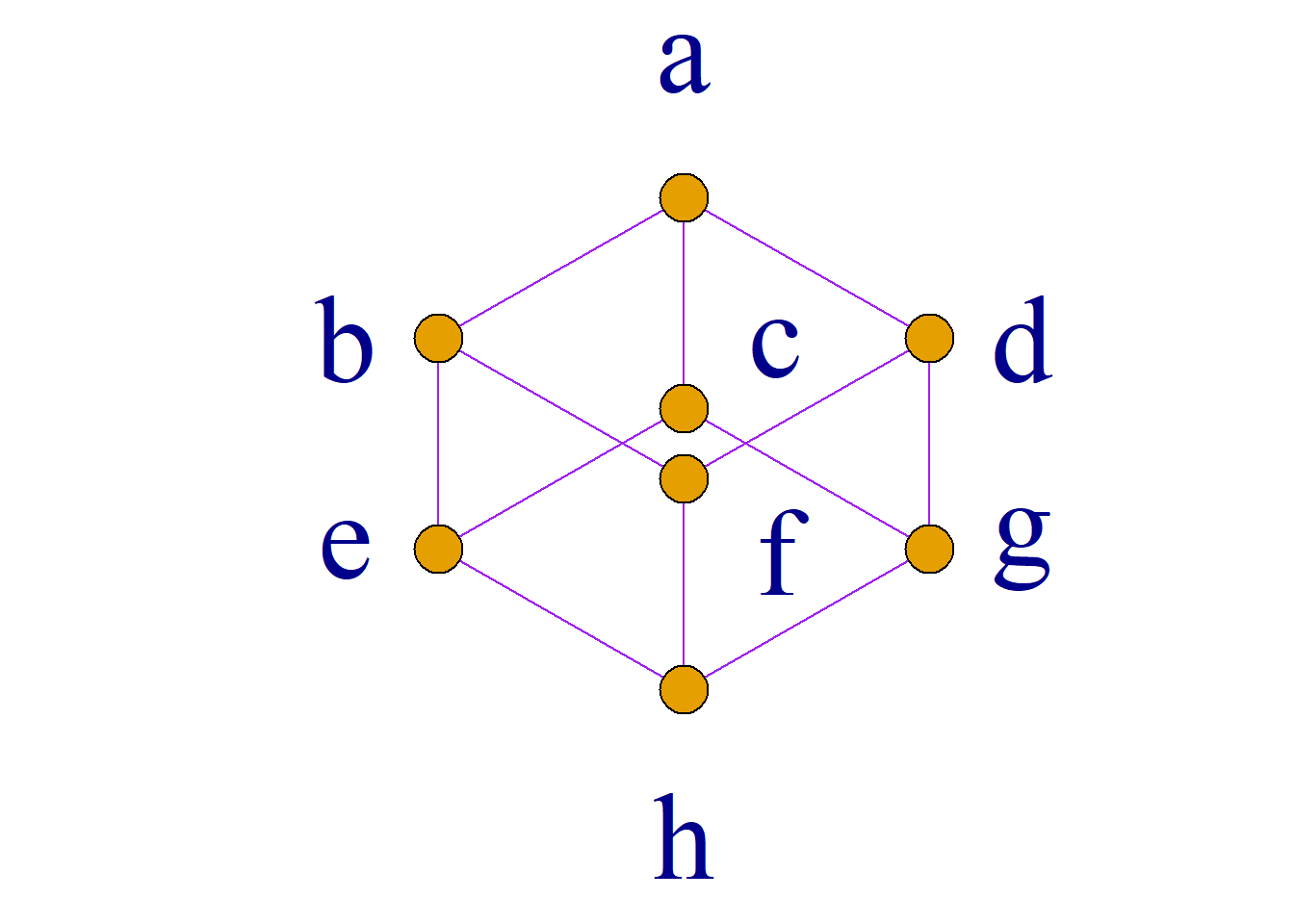
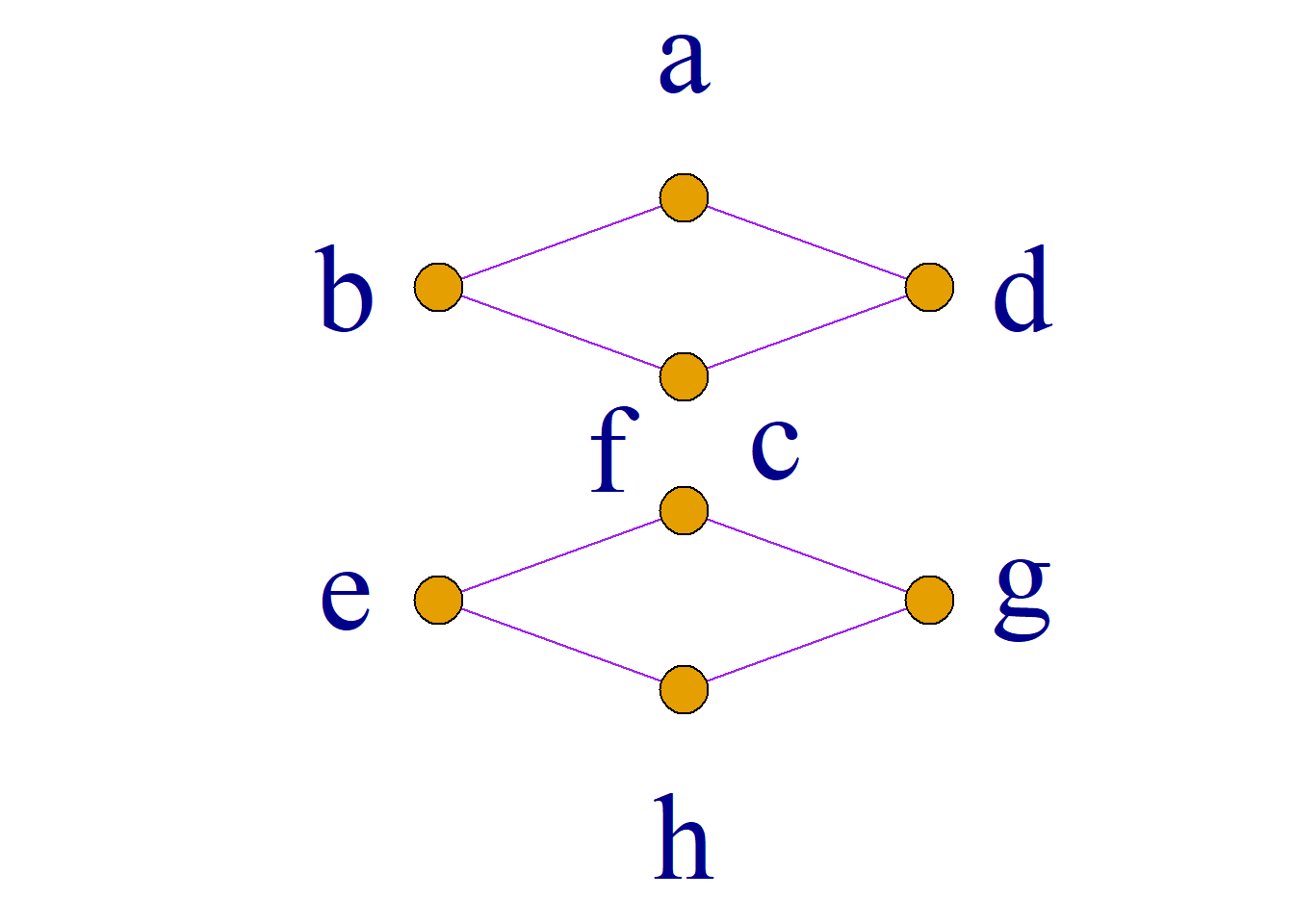
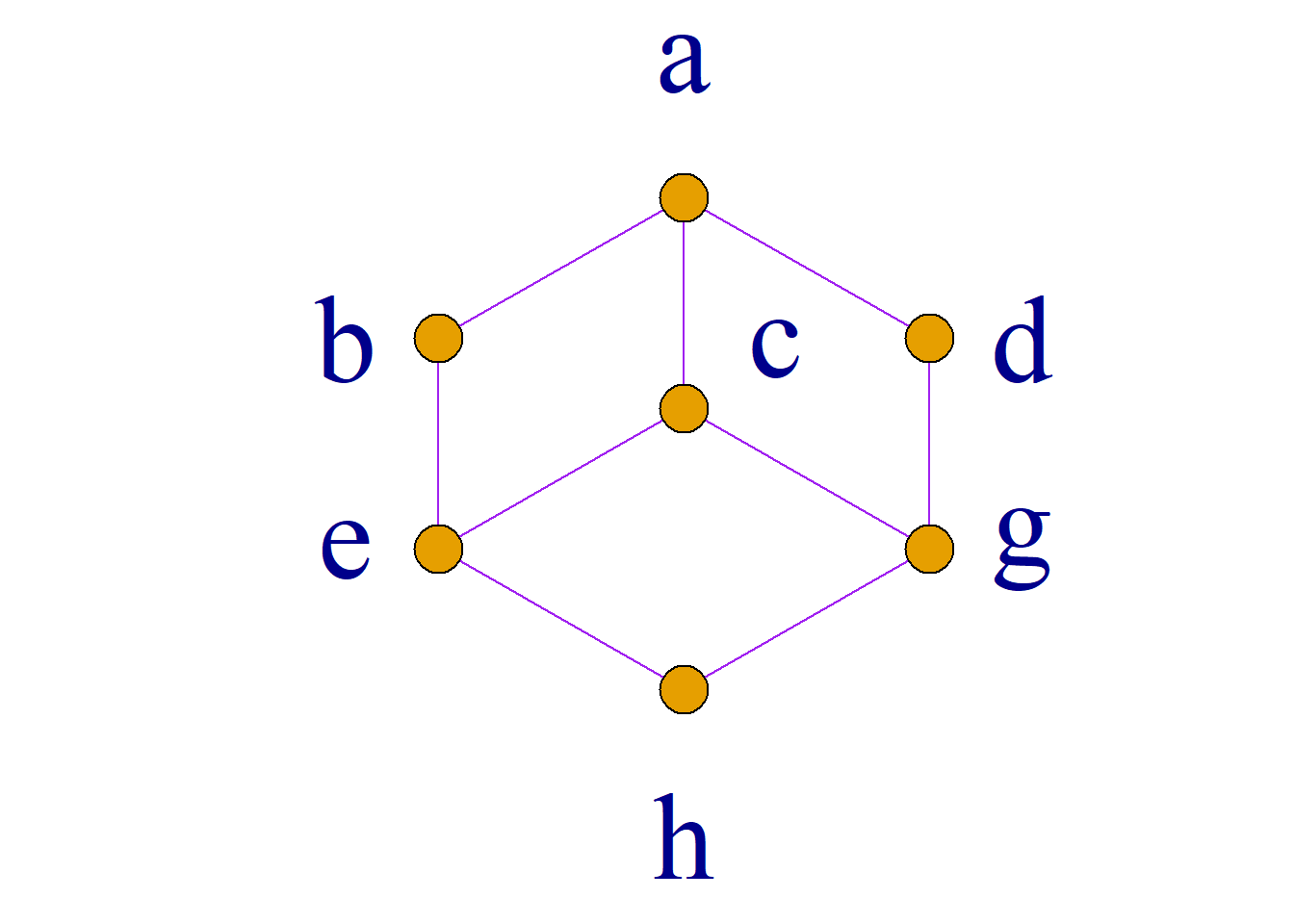
Example: Suppose \({\langle}L, {\leq}{\rangle}\) is a lattice, where: \[L=\{a, b, c, d, e, f, g, h, \},\] The Hasse diagram is shown in the figure:
Take \[S_1=\{a, b, d, f\}\] \[S_2=\{c, e, g, h\}\] \[S_3=\{a, b, c, d, e, g, h\}\] Determine which of \(S_1\), \(S_2\) and \(S_3\) can form the sublattice of \(L\).
Example: Suppose \({\langle}L, {\leq}{\rangle}\) is a grid, \(a{\in}L, S{\subseteq}L\) is defined as: \[S=\{x|x{\in}L, a{\leq}x\}\] Then \({\langle}S, {\leq}{\rangle}\) is the sublattice of \({\langle}L, {\leq}{\rangle}\).
Proof: For \({\forall}x_1, x_2{\in}S{\subseteq}L\), we have: \[x_1{\vee}x_2{\in}L, x_1{\wedge}x_2{\in}L,\,\,\,a{\leq}x_1, a{\leq}x_2\] Obtained: \(a{\leq}x_1{\vee}x_2\), \(a{\leq}x_1{\wedge}x_2\),
Therefore: \(x_1{\vee}x_2{\in}S\), \(x_1{\wedge}x_2{\in}S\),
Therefore \({\langle}S, {\leq}{\rangle}\) is the sublattice of \({\langle}L, {\leq}{\rangle}\).
Homomorphisms of Lattice
Definition: Suppose \({\langle}L, {\vee}, {\wedge}{\rangle}\) and \({\langle}S, {\bigoplus}, {\bigotimes}{\rangle}\) are two grids. If there is a mapping \(f\):\(L{\rightarrow}S\), then for \({\forall}a, b{\in}L\), there is:
\[f(a{\vee}b)=f(a){\bigoplus}f(b)\] \[f(a{\wedge}b)= f(a){\bigotimes}f(b)\]
Then \(f\) is said to be a lattice homomorphic mapping from \({\langle}L, {\vee}, {\wedge}{\rangle}\) to \({\langle}S, {\bigoplus}, {\bigotimes}{\rangle}\), referred to as homomorphic mapping.
If \(f\) is injective, surjective or bijective, then \(f\) is said to be monomorphic mapping, full homomorphic mapping and isomorphic mapping respectively.
In particular, the lattice homomorphic mapping from \({\langle}L, {\vee}, {\wedge}{\rangle}\) to \({\langle}L, {\vee}, {\wedge}{\rangle}\) is called automorphic mapping; The lattice isomorphism mapping from \({\langle}L, {\vee}, {\wedge}{\rangle}\) to \({\langle}L, {\vee}, {\wedge}{\rangle}\) is called automorphism mapping.
If there is an isomorphic mapping from \({\langle}L, {\vee}, {\wedge}{\rangle}\) to \({\langle}S, {\bigoplus}, {\bigotimes}{\rangle}\), it is called \({\langle}L, {\vee}, {\wedge}{\rangle}\) and \({\langle}S, {\bigoplus}, {\bigotimes}{\rangle}\) are isomorphic. Two isomorphic Getchhasian graphs are the same.
Example: Suppose \({\langle}Z^+, {\vee}, {\wedge}{\rangle}\) is a lattice, where \({\vee}, {\wedge}\) is defined as for any \(m, n{\in}Z^+\), we have: \[m{\vee}n=max\{m, n\}, m{\wedge}n=min\{m, n\}\] Also assume the grid \({\langle}S, {\bigoplus}, {\bigotimes}{\rangle}\), where: \(S=\{3^k|k{\in}Z^+\}\). Define the binary operations \({\bigoplus}\) and \({\bigotimes}\) on \(S\) as: for any \(3^m, 3^n{\in}S\), there is: \[3^m{\bigoplus}3^n=3^{max\{m, n\}},\,\,\,3^m{\bigotimes}3^n=3^{min\{m, n\}}.\]
Define the bijective function \(f:m{\rightarrow}3^m\) from \(Z^+\) to \(S\). Verify: \(f\) is an isomorphic mapping from \({\langle}Z^+, {\vee}, {\wedge}{\rangle}\) to \({\langle}S, {\bigoplus}, {\bigotimes}{\rangle}\).
Proof: For \({\forall}m, n{\in}Z^+\).
\[f (m{\vee}n) = f (max\{m, n\})=3^{max\{m, n\}}=3^m{\bigoplus}3^n = f (m){\bigoplus}f (n)\] \[f (m{\wedge}n) = f (min\{m, n\})=3^{min\{m, n\}}=3^m{\bigotimes}3^n = f (m){\bigotimes}f (n)\] Therefore, \(f\) is a lattice homomorphic mapping from \({\langle} Z^+, {\vee}, {\wedge}{\rangle}\) to \({\langle}S, {\bigoplus}, {\bigotimes}{\rangle}\).
And because \(f\) is bijective, \(f\) is also an isomorphic mapping from \({\langle}Z^+, {\vee}, {\wedge}{\rangle}\) to \({\langle}S, {\bigoplus}, {\bigotimes}{\rangle}\).
Definition: Suppose \({\langle}L, {\leq}_L{\rangle}\) and \({\langle}S, {\leq}_S{\rangle}\) are two lattices. If there is a mapping \(f:L{\rightarrow}S\), then any element \(a\), \(b\) in \(L\). When \(a{\leq}_Lb\), there is \(f(a){\leq}_Sf(b)\), then \(f\) is said to be a lattice order-preserving mapping (order-preserving mapping) from \({\langle}L, {\leq}_L{\rangle}\) to \({\langle}S, {\leq}_S{\rangle}\), which is referred to as order-preserving mapping.
Theorem: Suppose \({\langle}L, {\leq}_L{\rangle}\) and \({\langle}S, {\leq}_S{\rangle}\) are two lattice.
Mapping \(f:L{\rightarrow}S\), if \(f\) is a homomorphic mapping from \({\langle}L, {\vee}, {\wedge}{\rangle}\) to \({\langle}S, {\bigoplus}, {\bigotimes}{\rangle}\), then \(f\) is an order-preserving mapping.
That is, for any \(a, b{\in}L\), if \(a{\leq}_Lb\), there is: \(f(a){\leq}_Sf(b)\).
Among them: \({\leq}_L\) is the partial ordering relationship on the set \(L\) corresponding to the operations \({\vee}\) and \({\wedge}\), \({\leq}_S\) is the partial ordering relationship on the set \(S\) corresponding to the operations \({\bigoplus}\) and \({\bigotimes}\).
Example: \({\langle}S, {\leq}{\rangle}\) is a lattice, where \(S=\{a, b, c, d, e\}\), As shown in the figure, \({\langle}P(S), {\subseteq}{\rangle}\) is a power set lattice. Define mapping: \(f:S{\rightarrow}P(S)\), so that \({\forall}x{\in}S\), we have: \[f(x)=\{y|y{\in}S, y{\leq}x\}\] Ask whether \(f\) is an order-preserving mapping? Is it a homomorphic mapping?
Solution: \(f(a)=\{y|y{\in}S, y{\leq}a\}=\{a, b, c, d, e\}\) \[f(b)=\{y|y{\in}S, y{\leq}b\}=\{b, e\}\] \[f(c)=\{y|y{\in}S, y{\leq}c\}=\{c, e\}\] \[f(d)=\{y|y{\in}S, y{\leq}d\}=\{d, e\}\] \[f(e)=\{y|y{\in}S, y{\leq}e\}=\{e\}\] When \(x{\leq}y\) is \(f(x){\subseteq}f(y)\), so \(f\) is an order-preserving mapping.
However, \(b{\vee}d=a\), \(f(b{\vee}d){\neq}f(b){\cup}f(d)\). Therefore \(f\) is not a homomorphic mapping.
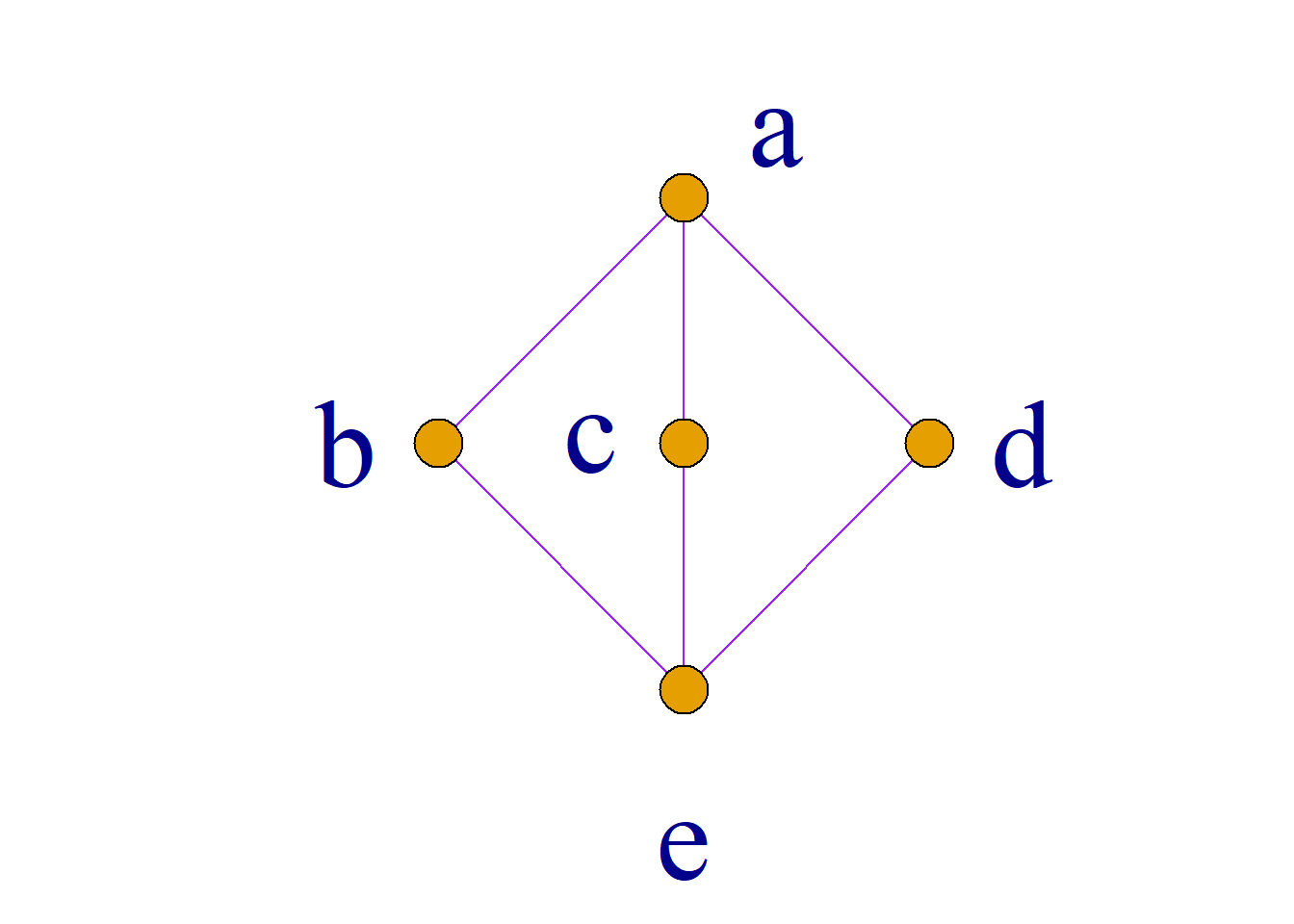
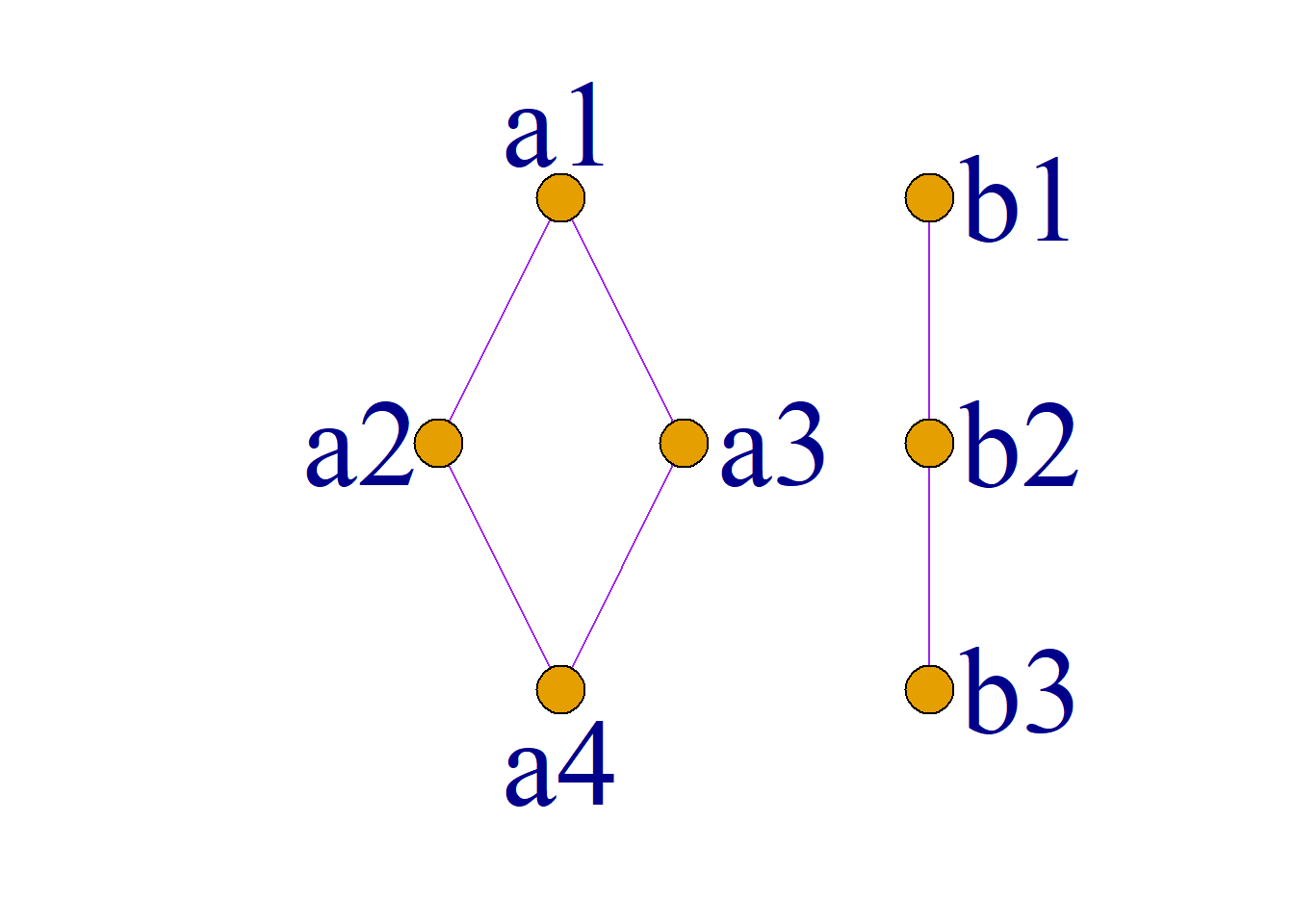
Example: As shown in the figure, the lattices \({\langle}L, {\leq}_L{\rangle}\) and \({\langle}S, {\leq}_S{\rangle}\) represented by the two Hasse diagrams define the mapping:
\(f(a_1)=b_1\), \(f(a_2)= b_2\)
\(f(a_3)= b_2\), \(f(a_4)= b_3\)
Obviously \(f\) is an order-preserving mapping from \({\langle}L, {\leq}_L{\rangle}\) to \({\langle}S, {\leq}_S{\rangle}\);
But it is not a homomorphic mapping. because:
\(f(a_2{\vee}_La_3)=f(a_1)=b_1\),
\(f(a_2){\vee}_Sf(a_3)=b_2{\vee}_Sb_2 =b_2\),
\(f(a_2{\vee}_{L}a_3){\neq}f(a_2){\vee}_Sf(a_3)\).
Distribution and complementation
Distribution grid
Definition: Suppose \({\langle}L, {\vee}, {\wedge}{\rangle}\) is a lattice. If \({\vee}\) satisfies the distributive law for \({\wedge}\) and \({\wedge}\) for \({\vee}\), that is, for any \(a, b, c{\in}L\), there is: \[a{\vee}(b{\wedge}c) = (a{\vee}b){\wedge}(a{\vee}c)\] \[a{\wedge}(b{\vee}c) = (a{\wedge}b){\vee}(a{\wedge}c)\] Then \({\langle}L, {\vee}, {\wedge}{\rangle}\) is said to be a distributive lattice.
Try to prove: \({\langle}P(S), {\cup}, {\cap}{\rangle}\) is a distribution lattice. Among them, \(S\) is any set, \(P(S)\) is the power set of \(S\), \({\cup}\) is the union of sets, and \({\cap}\) is the intersection of sets.
prove: Since \({\langle}P(S), {\cup}, {\cap}{\rangle}\) is a lattice, And for any \(A, B, C{\in}P(S)\), we have \[A{\cup}(B{\cap}C)=(A{\cup}B){\cap}(A{\cup}C),\,\,\,A{\cap}(B{\cup}C)=(A{\cap}B){\cup}(A{\cap}C)\] is established, so \({\langle}P(S), {\cup}, {\cap}{\rangle}\) is a distributive lattice.
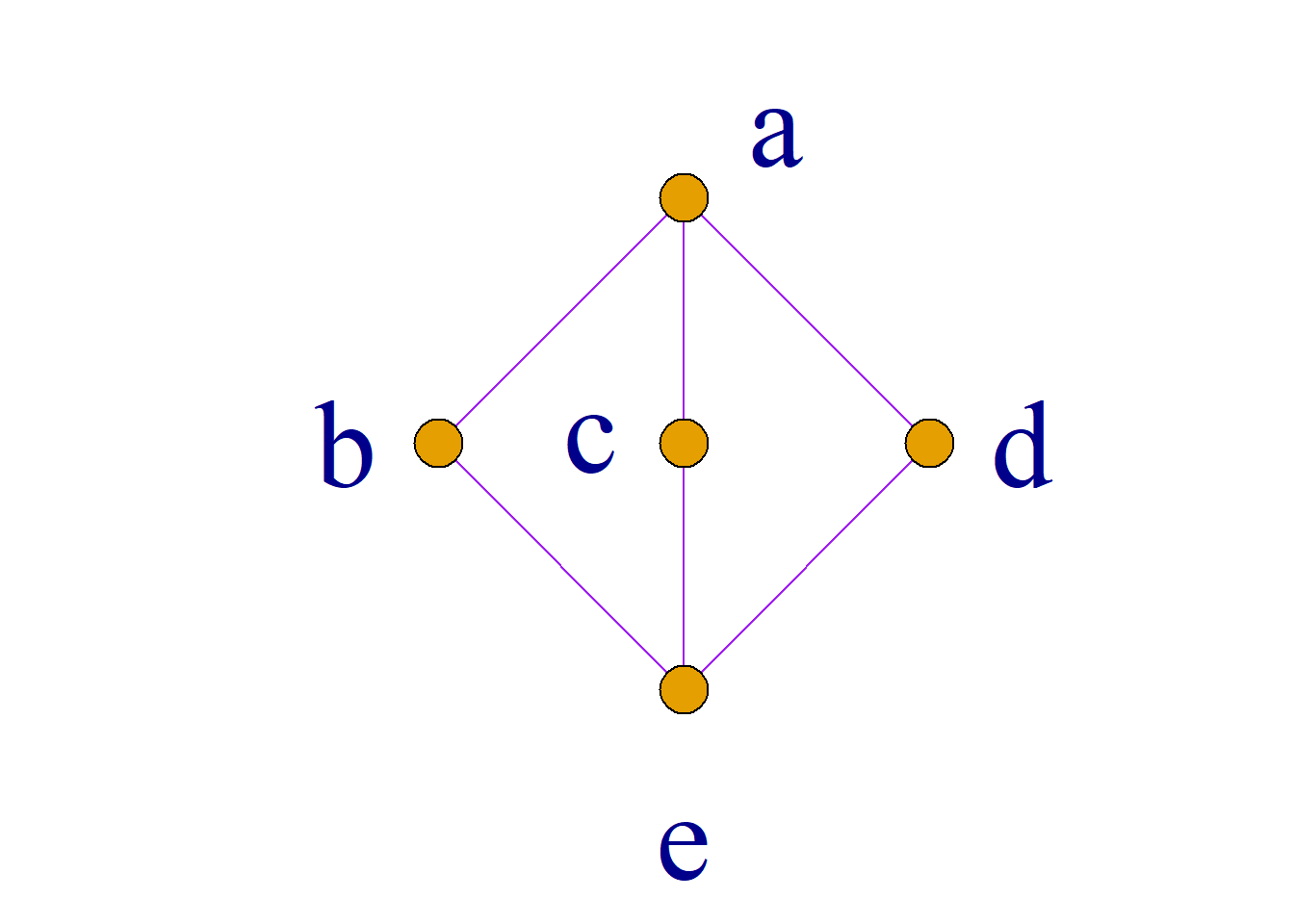
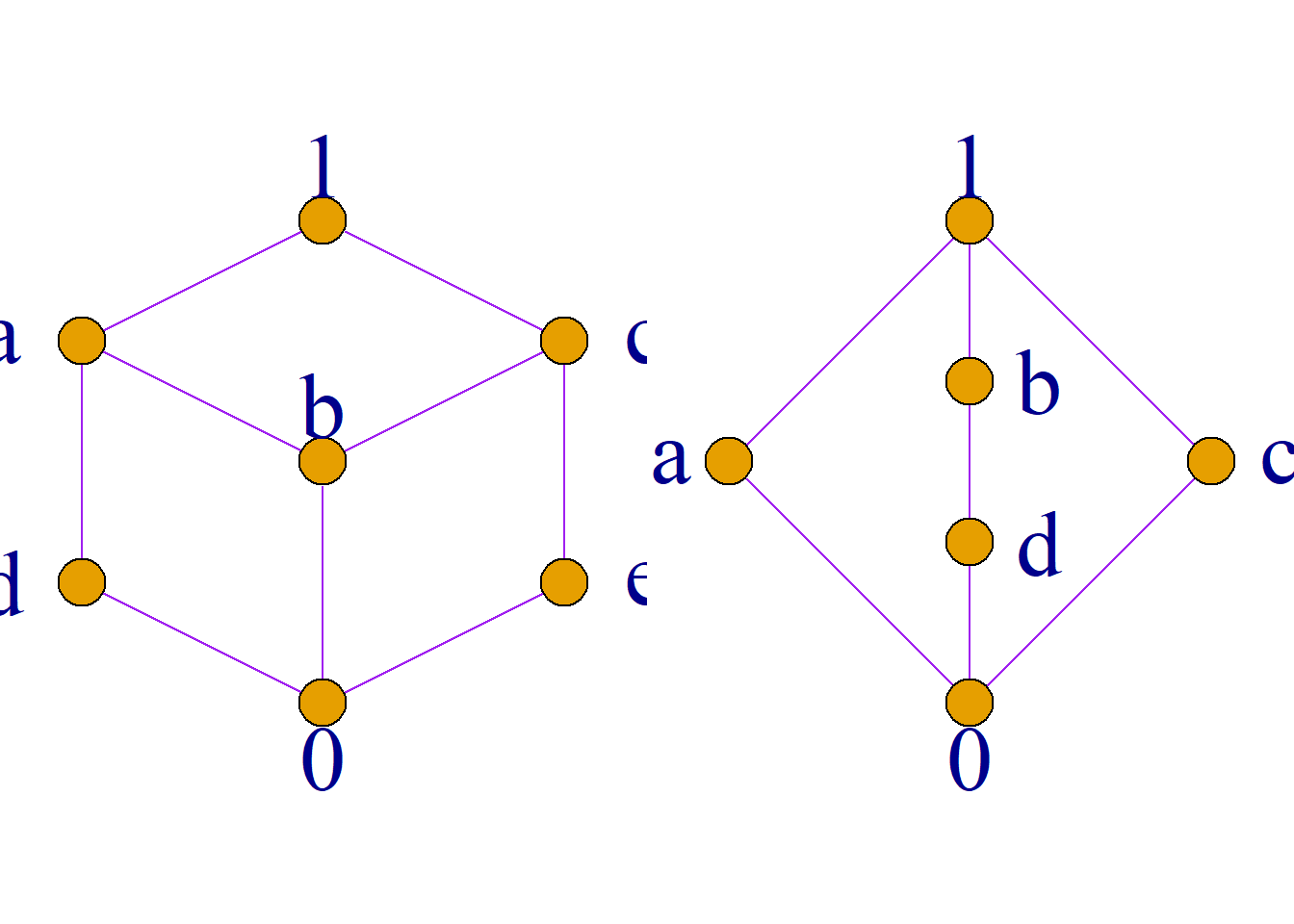
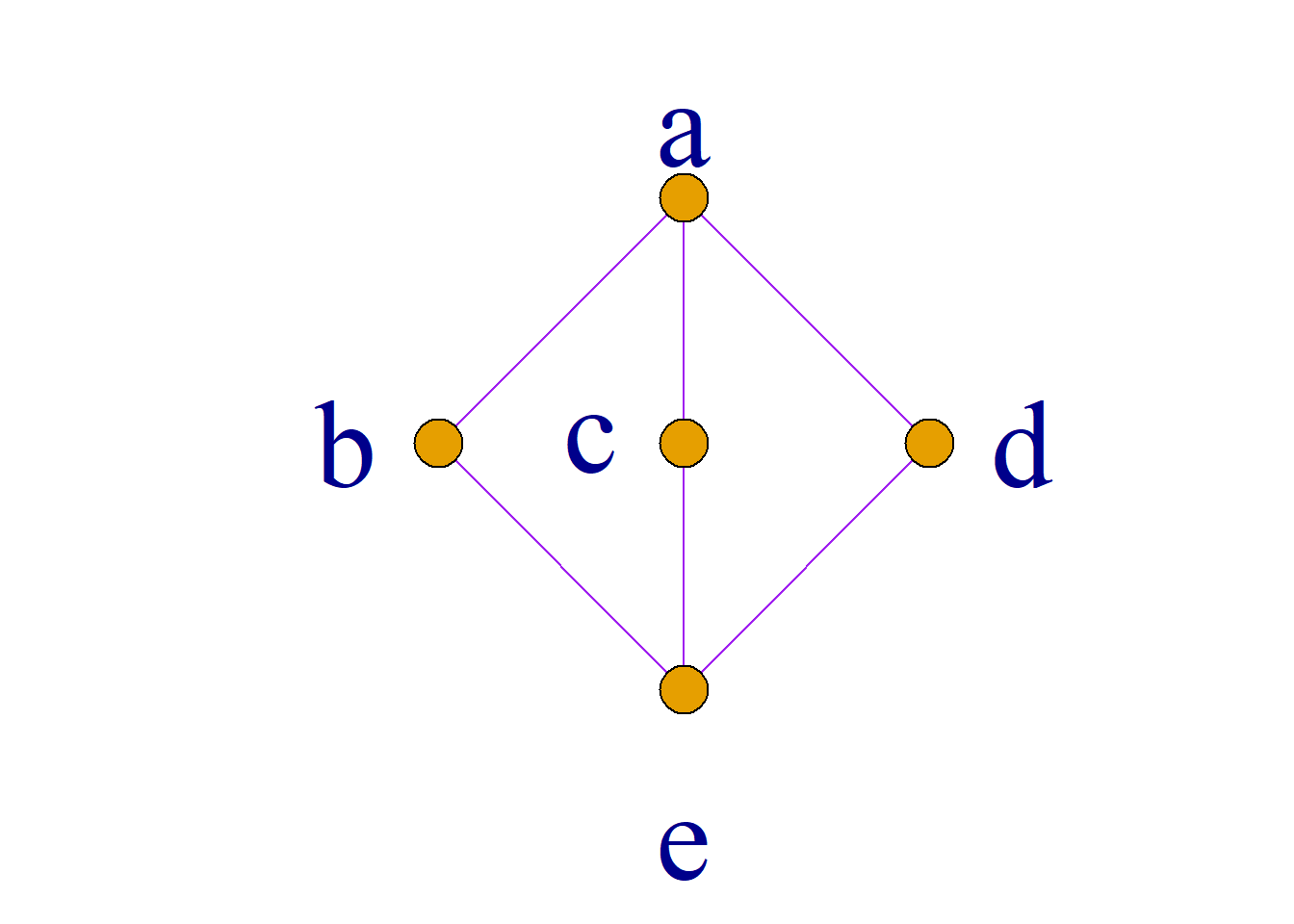
An example that is not a distribution grid (diamond grid):
\[b{\wedge}(c{\vee}d)=b{\wedge}a=b\]
\[(b{\wedge}c){\vee}(b{\wedge}d)=e{\vee}e=e\] so:
\[b{\wedge}(c{\vee}d)≠(b{\wedge}c){\vee}(b{\wedge}d)\]
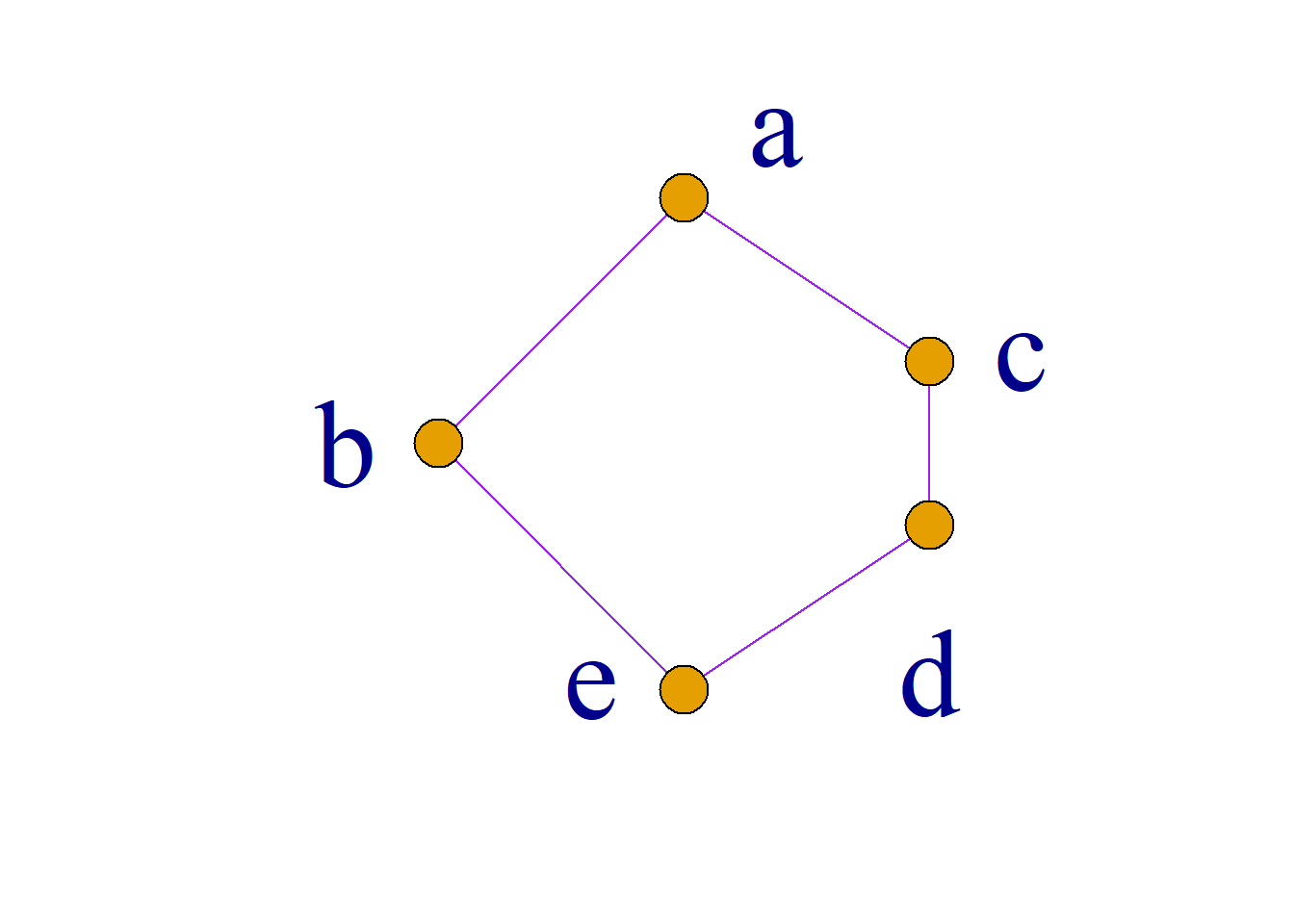
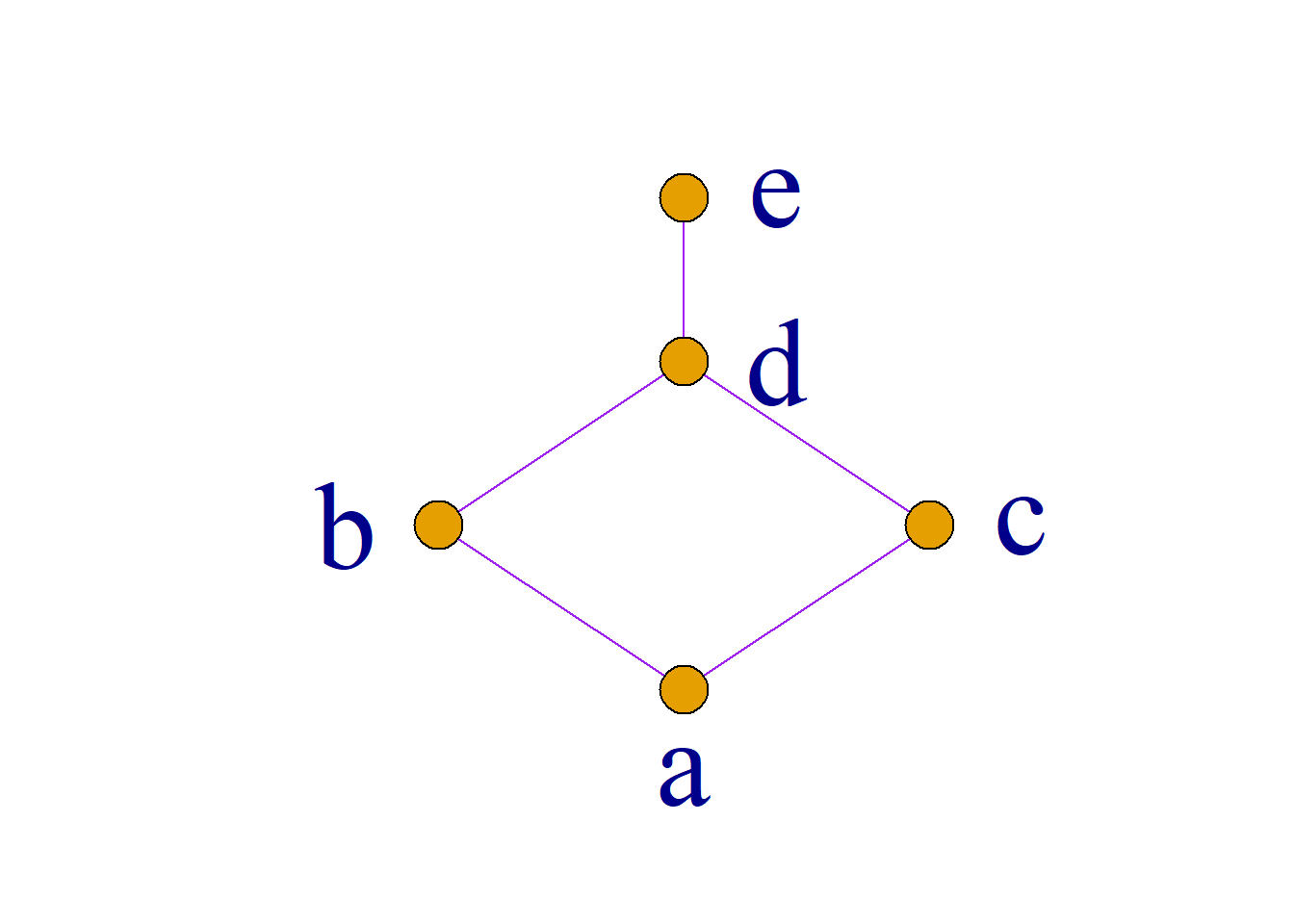
Examples that are not distribution grids (pentagonal grid):
\[c{\wedge}(b{\vee}d)=c{\wedge}a=c\]
\[(c{\wedge}b){\vee}(c{\wedge}d)=e{\vee}d=d\] so:
\[c{\wedge}(b{\vee}d){\neq}(c{\wedge}b){\vee}(c{\wedge}d).\]
Theorem: In the lattice \({\langle}L, {\vee}, {\wedge}{\rangle}\), if the intersection-preserving operation \({\wedge}\) is distributable to the union-preserving operation \({\vee}\), then the union-preserving operation \({\vee}\) must also be distributable to the intersection-preserving operation \({\wedge}\). vice versa.
Proof: Let \(a, b, c\) be any elements in the lattice, if \[a{\wedge}(b{\vee}c)=(a{\wedge}b){\vee}(a{\wedge}c)\] but \[(a{\vee}b){\boxed\wedge}(a{\boxed\vee}c)\] \[=((a{\vee}b){\boxed\wedge}a){\boxed\vee}((a{\vee}b){\boxed\wedge}c)\] \[=a{\vee}((a{\boxed\vee}b){\boxed\wedge}c)\] \[=a{\vee}({(a{\boxed\wedge}c){\boxed\vee}(b{\boxed\wedge}c)})\] \[=a{\vee}(b{\wedge}c).\] The other half can prove the same thing.
Theorem: Suppose \({\langle}L, {\vee}, {\wedge}{\rangle}\) is a distributive lattice, for any \(a, b, c{\in}L\), if \(a{\wedge}b=a{\wedge}c, a{\vee}b=a{\vee}c\) Established, then \(b=c\).
Proof: Because \((a{\wedge}b){\vee}c=(a{\wedge}c){\vee}c=c\), and \[(a{\wedge}b){\vee}c=(a{\vee}c){\wedge}(b{\vee}c)\] \[=(a{\vee}b){\wedge}(b{\vee}c)\] \[=b{\vee}(a{\wedge}c)\] \[=b{\vee}(a{\wedge}b)\] \[=b\] Therefore \(b=c\).
Theorem: The necessary and sufficient conditions for the lattice \({\langle}L, {\vee}, {\wedge}{\rangle}\) to be a distributive lattice are: \({\langle}L, {\vee}, {\wedge}{\rangle}\) does not contain any sublattice isomorphic to the diamond lattice and the pentagonal lattice.
There is a complement
Definition: For the lattice \({\langle}L, {\vee}, {\wedge}{\rangle}\), if the number of elements in \(L\) is limited, then \({\langle}L, {\vee}, {\wedge}{\rangle}\) is called finite lattice.
Example: For the set \(S=\{a, b\}\), then \({\langle}P(S), {\cup}, {\cap}{\rangle}\) is a finite lattice.
Because: \(P(S)=\{\phi, \{a\}, \{b\}, \{a, b\}\}\) is a finite set.
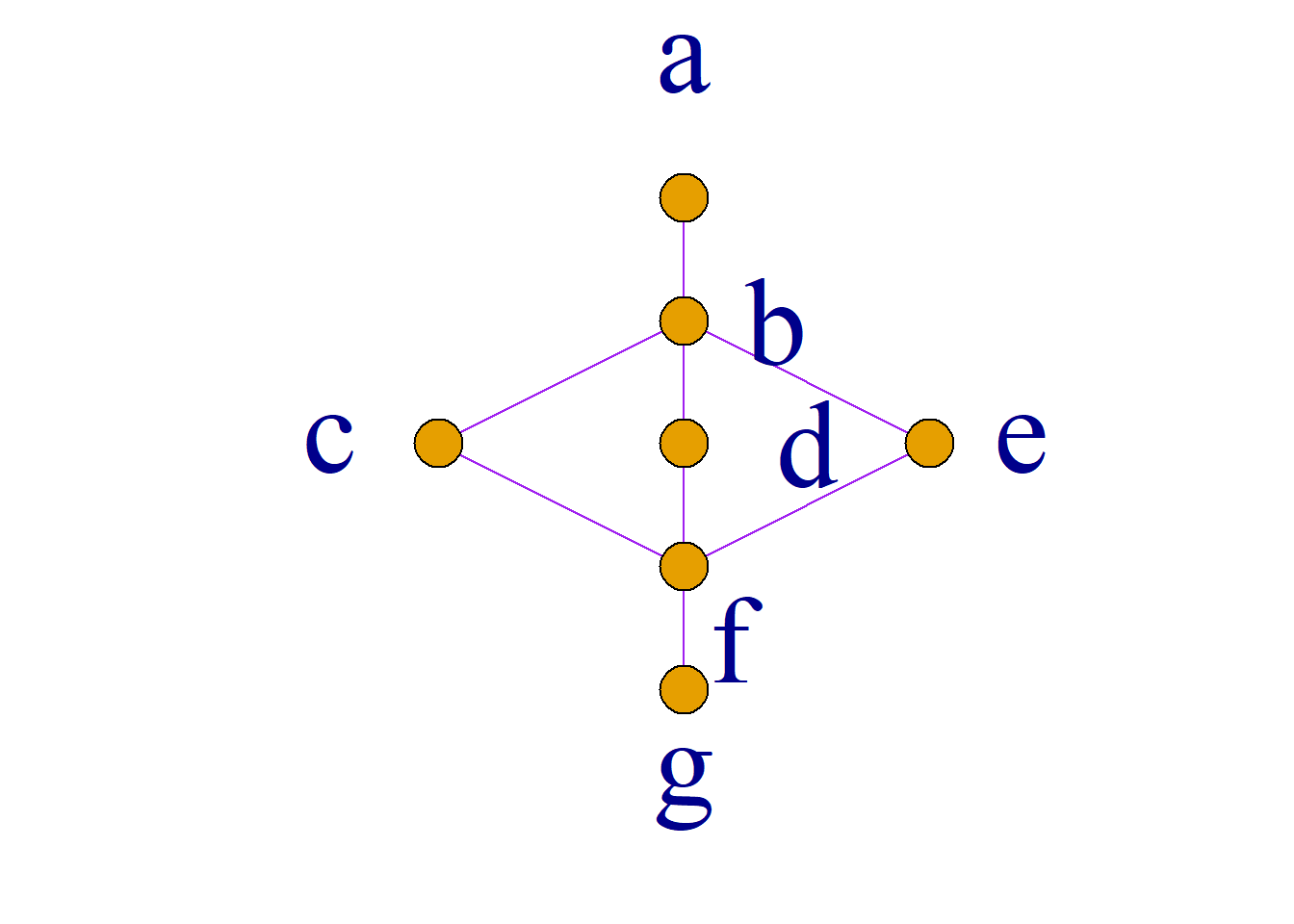
Example: For the lattice \({\langle}L, {\leq}{\rangle}, {\leq}\), the Haas diagram is as shown in the figure,
Then \({\langle}L, {\leq}{\rangle}\) is a finite lattice.
Definition: For the lattice \({\langle}L, {\vee}, {\wedge}{\rangle}\), if there is an element \(a{\in}L\), and for \({\forall}x{\in}L\), there is \(x{\leq}a(a{\leq}x)\), then \(a\) is said to be a maximum (minimum) element of the lattice \(L\).
If a lattice has a minimum element and a maximum element, they are called the bounds of the lattice, and \(\mathbf{0}\) and \(\mathbf{1}\) are used to represent the minimum element and maximum element respectively.
Example: The power set lattice \({\langle}P(S), {\subseteq}{\rangle} ({\langle}P(S), {\cup}, {\cap}{\rangle})\) has a maximum element S and a minimum element \(\phi\). For example: if \(S=\{a, b\}\), \[P(S)=\{\phi, \{a\}, \{b\}, \{a, b\}\},\,\,\mathbf{1}=\{a, b\}, \mathbf{0} = \phi.\]
Definition: If a lattice has both a minimum element and a maximum element, the lattice is called a bounded lattice.
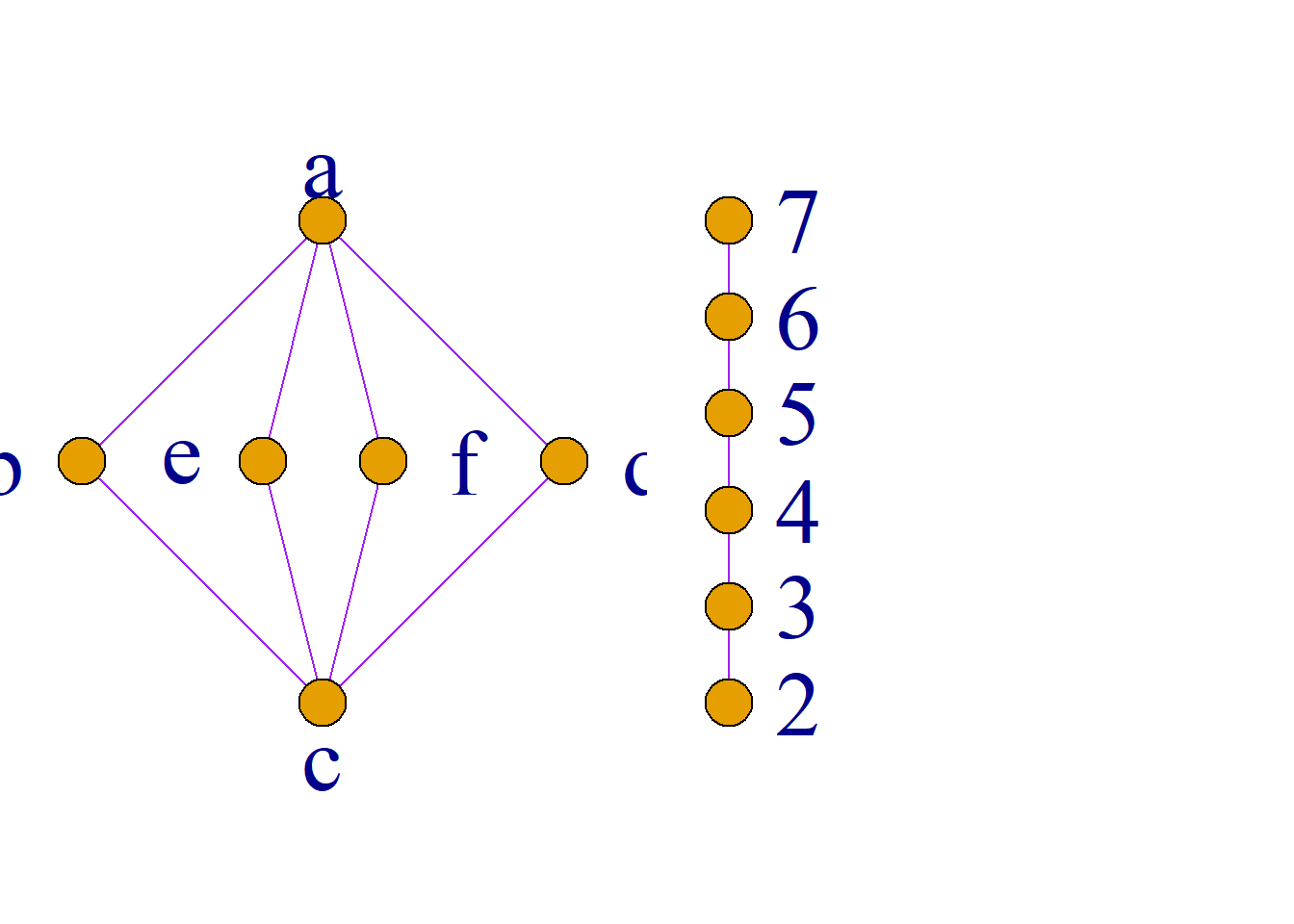
Example: Suppose \(S=\{2, 3, 4, 5, 6, 7\}\), for the less than or equal relationship between ordinary numbers \({\leq}, {\langle}S, {\leq}{\rangle}\) form a bounded lattice. The minimum element \(\mathbf{0}=2\), the maximum element \(\mathbf{1}=7\).
Finite lattice are all bounded lattice. For example, power set lattice \({\langle}P(S), {\subseteq}{\rangle}\), \(S=\{a, b\}\) It is bounded.
Example: Assume \(N\) natural number set, for the less than or equal relationship between ordinary numbers \({\leq}\), \({\langle}N, {\leq}{\rangle}\) form a lattice.
Among them, the minimum element \(\mathbf{0}=0\) has no maximum element. It is not a bounded lattice.
Theorem: Suppose \({\langle}L, {\vee}, {\wedge}{\rangle}\) is a bounded lattice, then for any \(a{\in}L\), Must have:
(1)\(a{\vee}\mathbf{1}=\mathbf{1}\), \(a{\wedge}\mathbf{1}=a\); (2)\(a{\vee}\mathbf{0}=a\), \(a{\wedge}\mathbf{0}=\mathbf{0}\).
prove: (1) Because \(a{\vee}\mathbf{1}{\in}L\), there is \(a{\vee}\mathbf{1}{\leq}\mathbf{1}\). And because \(\mathbf{1}{\leq}a{\vee}\mathbf{1}\), therefore \(a{\vee}\mathbf{1}=\mathbf{1}\).
Because \(a{\leq}a\), \(a{\leq}\mathbf{1}\), there is \(a{\leq}a{\wedge}\mathbf{1}\). And because \(a{\wedge}\mathbf{1}{\leq}a\), therefore \(a{\wedge}\mathbf{1}=a\). (2) can be proved similarly.
Definition: Let \({\langle}L, {\vee}, {\wedge}{\rangle}\) be a bounded lattice, for an element \(a\) in \(L\).
If \(b{\in}L\) exists, such that \(a{\vee}b=\mathbf{1}\), \(a{\wedge}b=\mathbf{0}\), then \(b\) is said to be the complement of \(a\).
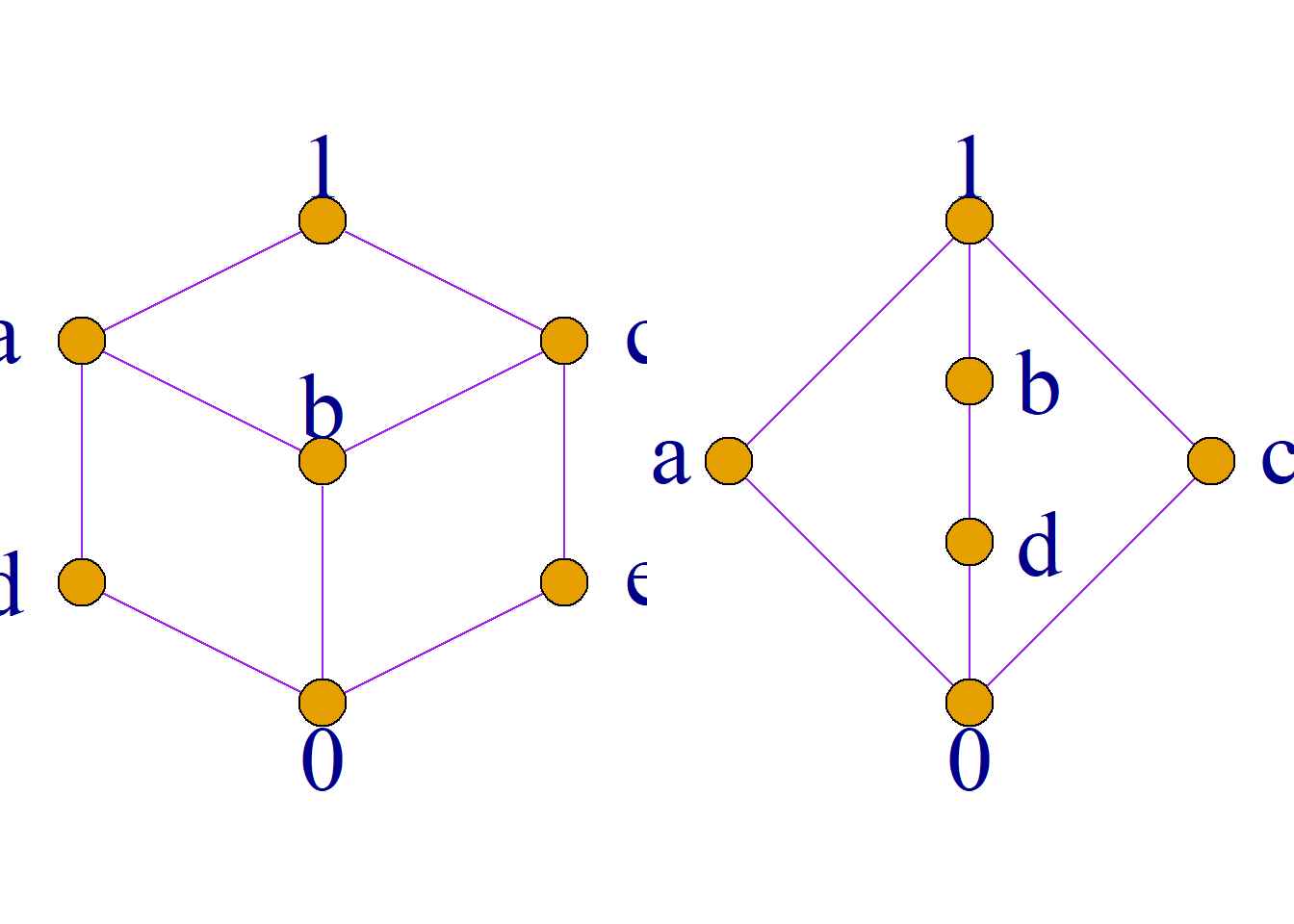
In the picture on the left, \(\mathbf{1}\) and \(\mathbf{0}\) are complementary; The complement of \(a\) is \(e\);
\(b\) has no complement; the complement of \(c\) is \(d\); The complements of \(d\) are \(c\) and \(e\);
The complements of \(e\) are \(a\) and \(d\).
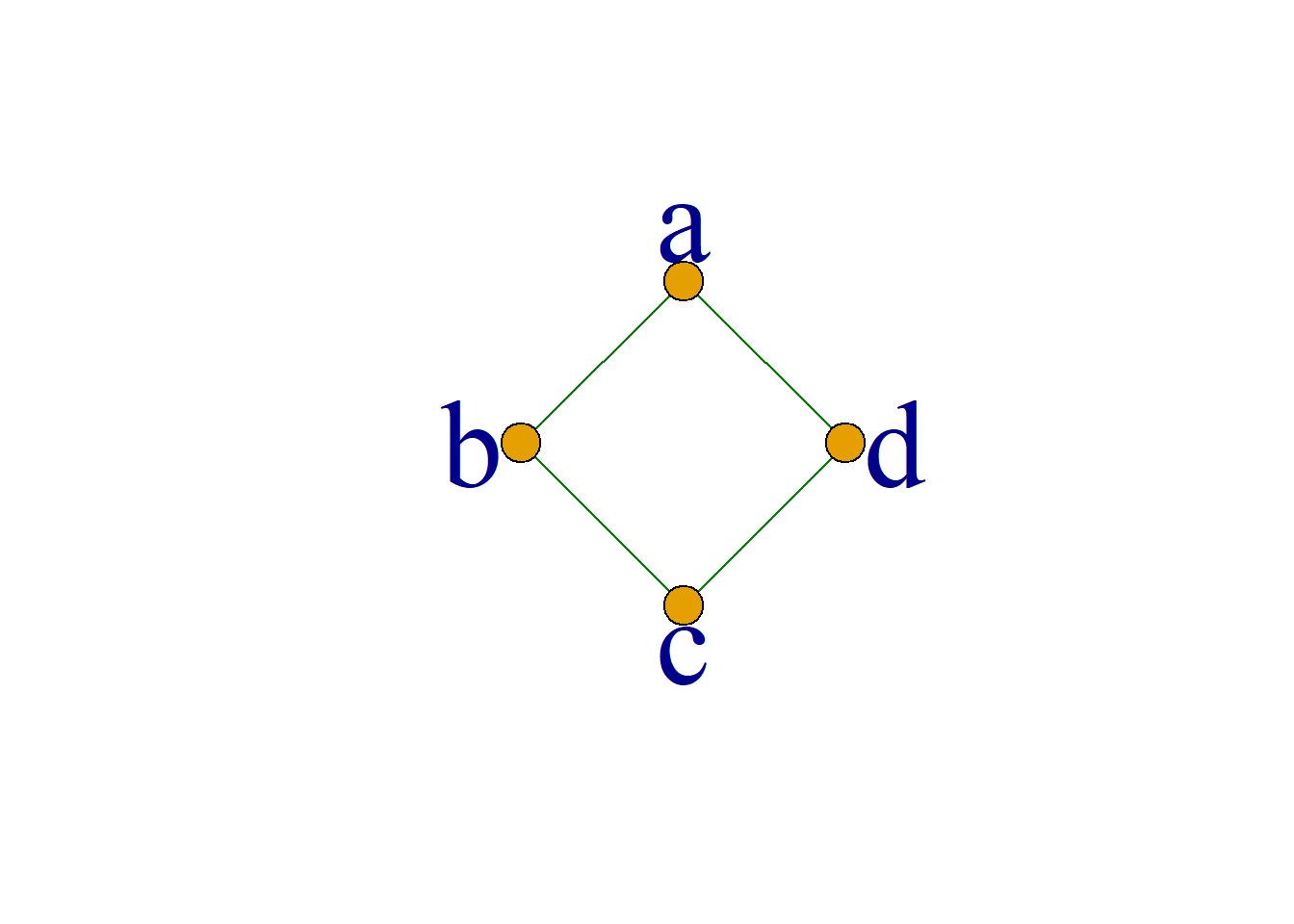
In the picture on the right, \(\mathbf{1}\) and \(\mathbf{0}\) are complementary; The complements of \(a\) are \(b\), \(c\) and \(d\);
The complements of \(b\) are \(a\) and \(c\); The complements of \(c\) are \(a\), \(b\) and \(d\);
The complements of \(d\) are \(a\) and \(c\).
Supplementary elements have the following characteristics:
The complements are mutual, that is, if \(b\) is the complement of \(a\), then \(a\) is also the complement of \(b\);
\(\mathbf{0}\) and \(\mathbf{1}\) are complements of each other;
Not every element in a bounded lattice has a complement, and even if it exists, it may not be unique.
Definition: In a bounded lattice \({\langle}L, {\vee}, {\wedge}{\rangle}\), if every element in \(L\) has a complement element, then this lattice is called complementary lattice.
Theorem: The complement of elements \(\mathbf{0}\) and \(\mathbf{1}\) in the complement \({\langle}L, {\vee}, {\wedge}{\rangle}\) is unique.
Definition: If a figure is both complementary and distributive, it is called complementary and distributive.
Example: Suppose \(S\) is a non-empty finite set, then \({\langle}P(S), {\cup}, {\cap}{\rangle}\) is a complementary partition.
Because \(\mathbf{1}= S\), \(\mathbf{0}=\phi\), and for any \(A{\in}P(S)\) (\(A{\subseteq}S\)), there is a unique complement element \({\sim}A=S-A{\in}P(S)\) (\({\sim}A{\subseteq}S\)), the complement of \(A\) is the complement of \(A\). \(A{\cup}{\sim}A=S\), \(A{\cap}{\sim}A=\phi\).
Theorem: The complement of every element in a complemented lattice is unique.
Proof (proof by contradiction): Suppose \({\langle}L, {\vee}, {\wedge}{\rangle}\) is a complemented distribution, \(a\) is an element in \(L\), assuming it has two complements \(b\) and \(c\), then:
\[a{\vee}b=\mathbf{1},\,\, a{\wedge}b=\mathbf{0},\,\,a{\vee}c=\mathbf{1},\,\, a{\wedge}c=\mathbf{0}\]
That is: \(a{\vee}b=a{\vee}c\), \(a{\wedge}b=a{\wedge}c\).
According to the properties of the distributive lattice, there is \(b=c\). So the complement of \(a\) is unique.
The unique complement of any element \(a\) in the complemented partition can be represented by \({\sim}a\) (or \(a^\prime\)).
Theorem: For every element \(a\) in the complementary distribution lattice, there is \((a^{\prime})^{\prime}=a\).(Composition Law)
Proof: Because \(a{\vee}a^{\prime}=\mathbf{1}, a{\wedge}a^{\prime}=\mathbf{0}\), From the commutative law: \(a^{\prime}{\vee}a=\mathbf{1}, a^{\prime}{\wedge}a=\mathbf{0}\), Therefore, the complement of \(a ^{\prime}\) is \(a\), and the uniqueness of the complement is \((a^{\prime})^{\prime}=a\).
Theorem (De Morgan’s law): Suppose \({\langle}L, {\vee}, {\wedge}{\rangle}\) is a complementary partition, then for any elements \(a\) and \(b\) in \(L\), we have
\((a{\vee}b)^{\prime}= a^{\prime}{\wedge}b^{\prime}\)
\((a{\wedge}b)^{\prime}= a^{\prime}{\vee}b^{\prime}\)
Proof: (1) From the distributive law we know:
\[(a{\vee}b){\vee}(a^{\prime}{\wedge}b^{\prime})=\] \[(a{\vee}b{\vee}a^{\prime}){\wedge}(a{\vee}b{\vee}b^{\prime}) =\mathbf{1}{\wedge}\mathbf{1}=\mathbf{1}\]
\[(a{\vee}b){\wedge}(a^{\prime}{\wedge}b^{\prime})=\] \[(a{\wedge}a^{\prime}{\wedge}b^{\prime}){\vee}(b{\wedge}a^{\prime}{\wedge}b^{\prime}) =\mathbf{0}{\vee}\mathbf{0}=\mathbf{0}\]
From the uniqueness of the complement, we can get \((a{\vee}b)^{\prime}= a^{\prime}{\wedge}b^{\prime}\). In the same way, formula (2) can be proved.
Theorem: For any elements \(a\) and \(b\) with complementary lattice, we have: \(a{\leq}b{\Leftrightarrow}a{\wedge}b^{\prime}=\mathbf{0}{\Leftrightarrow}a^{\prime}{\vee}b=\mathbf{1}\).
prove: \[a{\leq}b{\Rightarrow}a{\wedge}b^{\prime}=(a{\wedge}b^{\prime}){\vee}(b{\wedge}b^{\prime})=(a{\vee}b){\wedge}b^{\prime}=b{\wedge}b^{\prime}=\mathbf{0}.\] in turn, \[a{\wedge}b^\prime=\mathbf{0}{\Leftrightarrow}(a{\wedge}b^\prime)^\prime=a^\prime{\vee}b=\mathbf{1}\] \[{\Rightarrow}a{\vee}b=(a{\vee}b)\wedge(a^\prime{\vee}b)=(a{\wedge}a^\prime){\vee}b=b{\Rightarrow}a{\leq}b.\]
Definition: A complemented lattice is called Boolean algebra.
In the complemented distribution, since each element \(a\) has a unique complement \(a^{\prime}\), a unary operation \(^{\prime}\) can be defined so that \(a^{\prime}\) is the complement of \(a\). This unary operation is called complement operation.
Boolean algebra is generally represented by \({\langle}B, {\vee}, {\wedge}, ^{\prime}{\rangle}\) or \({\langle}B, {\vee}, {\wedge}, ^{\prime}, \mathbf{0}, \mathbf{1}{\rangle}\).
For example, Boolean algebra: \[{\langle}P(S), {\cup}, {\cap}, {\sim}{\rangle} or {\langle}P(S), {\cup}, {\cap}, {\sim}, \phi, S {\rangle}.\]
Definition: A Boolean algebra with a finite number of elements is called a finite Boolean algebra.
Definition: Let \({\langle}B, {\vee}, {\wedge}, ^{\prime}, \mathbf{0}, \mathbf{1}{\rangle}\) be a Boolean algebra, \(A{\subseteq}B\) and non-empty, if \({\langle}A, {\vee}, {\wedge}, ^{\prime}, \mathbf{0}, \mathbf{1}{\rangle}\) is also Boolean algebra, then \({\langle}A, {\vee}, {\wedge}, ^{\prime}, \mathbf{0}, \mathbf{1}{\rangle}\) is \({\langle}B, {\vee}, {\wedge}, ^{\prime}, 0, **Sub(Boolean) algebra** of 1{\rangle}\).
Theorem: Let \({\langle}B, {\vee}, {\wedge}, ^{\prime}, \mathbf{0}, \mathbf{1}{\rangle}\) be a Boolean algebra, \(A{\subseteq}B\) and \(A\) contain elements \(\mathbf{0}\) and \(\mathbf{1}\), if \(A\) operates on \({\vee}\), \({\wedge}\) and \(^\prime\) are closed, then \({\langle}A, {\vee}, {\wedge}, ^{\prime}, \mathbf{0}, \mathbf{1}{\rangle}\) is \({\langle}B, {\vee}, {\wedge}, ^{\prime}, \mathbf{0}, Subalgebras of \mathbf{1}{\rangle}\).
Definition: Let \({\langle}A, {\vee}, {\wedge}, ^{\prime}, \mathbf{0}, \mathbf{1}{\rangle}\) and \({\langle}B, {\vee}, {\wedge}, ^{\prime}, \mathbf{0}, \mathbf{1}{\rangle}\) be two Boolean algebras, If there is a function \(f\) from \(A\) to \(B\), such that for any \(a, b{\in}A\), there is: \[f(a{\vee}b)=f(a){\vee}f(b)\] \[f(a{\wedge}b)=f(a){\wedge}f(b)\] \[f(a^{\prime})=(f(a))^{\prime}\] Then \(f\) is said to be a Boolean algebra \({\langle}A, {\vee}, {\wedge}, ^{\prime}, \mathbf{0}, \mathbf{1}{\rangle}\) to a Boolean algebra \({\langle}B, {\vee}, {\wedge}, ^{\prime}, \mathbf{0}, Homomorphism (mapping) of \mathbf{1}{\rangle}\).
If \(f\) is injective, it is called single homomorphism;
If \(f\) is surjective, it is called full homomorphism;
If \(f\) is bijective, it is called isomorphism;
If there is an isomorphic mapping f, it is called Boolean algebra \({\langle}A, {\vee}, {\wedge}, ^{\prime}, \mathbf{0}, \mathbf{1}{\rangle}\) and Boolean algebra \({\langle}B, {\vee}, {\wedge}, ^{\prime}, \mathbf{0}, \mathbf{1}{\rangle}\) isomorphism.
Example: Let \(U={\langle}K, {\vee}, {\wedge}, {\sim}, \mathbf{0}_K, \mathbf{1}_K{\rangle}\) and \(V={\langle}L, {\cup}, {\cap}, -, \mathbf{0}_L, \mathbf{1}_L{\rangle}\) be two Boolean algebras, And let \(f\) be a homomorphic mapping from \(U\) to \(V\). That is, for any \(a, b{\in}K\), we have \[f(a{\vee}b)=f(a){\cup}f(b),\,\,f(a{\wedge}b)=f(a){\cap}f(b),\,\,f({\sim}a)=-f(a).\] Try to prove: \(f(\mathbf{0}_K)=\mathbf{0}_L\), \(f(\mathbf{1}_K)=\mathbf{1}_L\).
Proof: Because \(\mathbf{0}_K, \mathbf{1}_K{\in}K\), \(\mathbf{0}_L, \mathbf{1}_L{\in}L\), therefore: \[f(\mathbf{0}_K), f(\mathbf{1}_K){\in}L,\,\,f(\mathbf{0}_K)=f({\sim}\mathbf{1}_K)=-f(\mathbf{1}_K),\,\,f(\mathbf{1}_K)=f({\sim}\mathbf{0}_K)=-f(\mathbf{0}_K)\] It can be seen that \(f(\mathbf{0}_K)\) and \(f(\mathbf{1}_K)\) are complementary. so: \(f(\mathbf{0}_K){\cup}f(\mathbf{1}_K)=\mathbf{1}_L,\,\,f(\mathbf{0}_K){\cap}f(\mathbf{1}_K)=\mathbf{0}_L\).
again: \[f(\mathbf{1}_K)=f(\mathbf{0}_K{\vee}\mathbf{1}_K)=f(\mathbf{0}_K){\cup}f(\mathbf{1}_K)=\mathbf{1}_L\] \[f(\mathbf{0}_K)=f(\mathbf{0}_K{\wedge}\mathbf{1}_K)=f(\mathbf{0}_K){\cap}f(\mathbf{1}_K)=\mathbf{0}_L\] so: \(f(\mathbf{1}_K)=\mathbf{1}_L,\,\,f(\mathbf{0}_K)=\mathbf{0}_L\).